
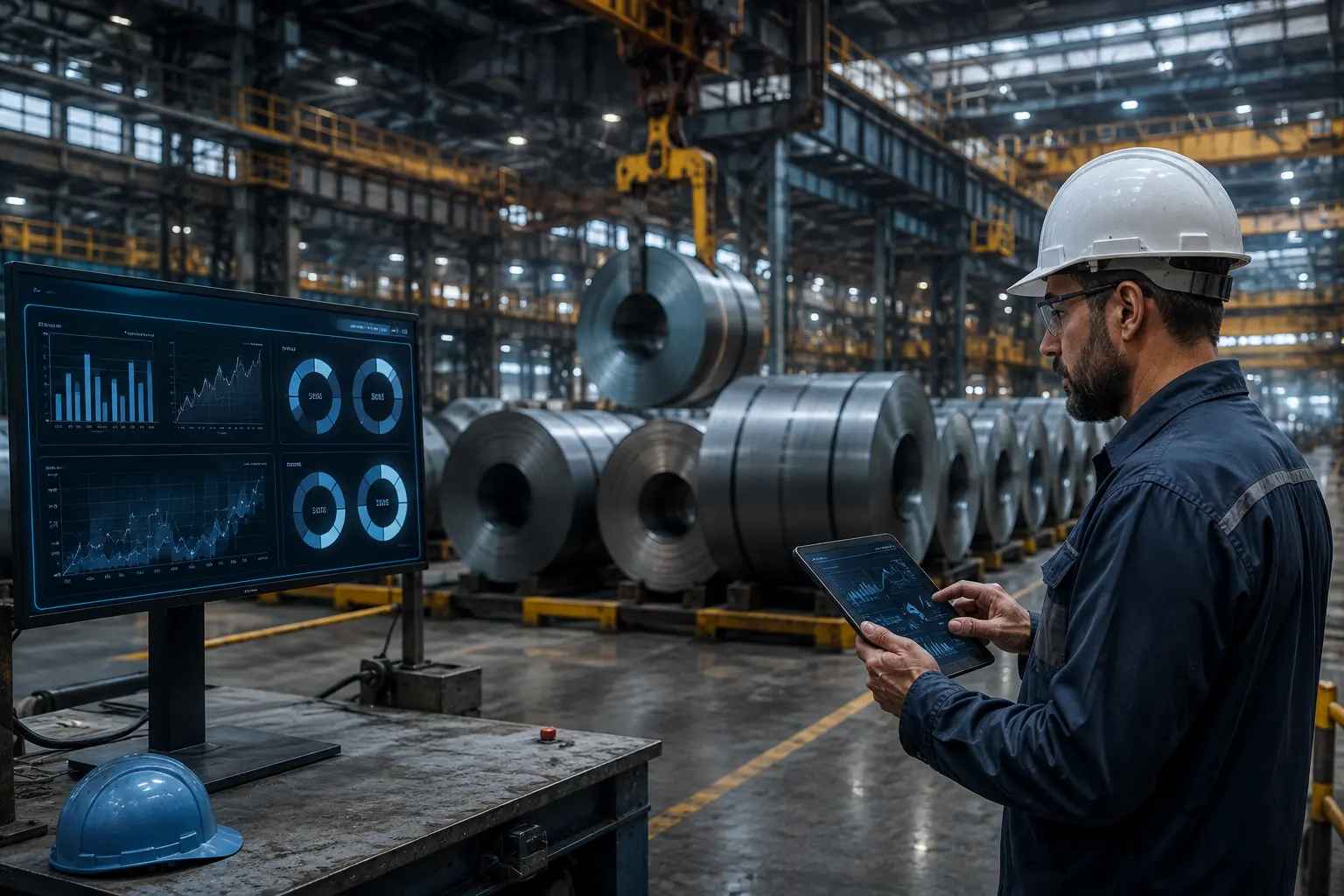
AI Functions for Coil Handling and Production in Metal Forming & Rolling
AI Software That Reads the Rolling Floor
From Mill Entry Credentialing to Coil Genealogy, AI Turns Identification Data into Operational Decisions
Metal forming and rolling facilities operate in environments where thousands of production events occur every shift. Steel coils, aluminum coils, work rolls, slabs, billets, strip products, and finished materials continuously move between receiving areas, reheating furnaces, hot rolling stands, tandem mills, reversing mills, annealing lines, pickling lines, slitting operations, inspection stations, warehouses, and shipping docks. Maintaining accurate visibility of personnel, material movement, production assets, and work-in-progress is essential for achieving production efficiency, quality consistency, inventory accuracy, and workplace safety.
MetalProcess AI provides AI software developed specifically for rolling operations where identification and location data become the foundation for operational decision support. Rather than simply collecting identification events, AI software analyzes relationships between people, assets, production activities, inventory movement, and manufacturing workflows to identify trends, predict operational conditions, and support faster decision making.
Artificial Intelligence of Things, commonly called AIoT or AI and IoT, combines artificial intelligence with IoT devices, sensors, connected equipment, and industrial systems. AIoT solutions may also use Industrial AI, Edge AI, machine learning, computer vision, and, in autonomous applications, Physical AI. Within rolling operations, these technologies transform identification data collected through RFID, BLE, GPS, and industrial communication systems into actionable software that improves production coordination while maintaining emphasis on identification and location rather than traditional monitoring systems.
Unlike IoT hardware, which identifies or locates physical objects, AI software evaluates operational patterns across the rolling facility. It correlates production events with personnel movement, material flow, equipment utilization, inventory status, and enterprise business systems. This enables production managers, warehouse supervisors, maintenance teams, quality engineers, and operations executives to make informed decisions based on continuously updated operational information.
Rather than replacing existing manufacturing software, MetalProcess AI complements manufacturing execution systems, warehouse management systems, enterprise resource planning software, computerized maintenance management software, and quality management systems. AI software continuously analyzes identification events generated throughout rolling operations and converts them into operational recommendations that improve manufacturing performance.
Overview of AI Functions for Rolling Operations
Rolling mills generate enormous volumes of operational information every hour. Personnel credentials are validated at secured production entrances, coils are transferred by overhead cranes, forklifts transport work rolls, automated material handling equipment moves inventory between production stages, and finished products are prepared for shipment. Every movement represents valuable operational information that can improve manufacturing decisions when analyzed correctly.
Traditional reporting methods often rely on historical production records and manual reconciliation after production has already occurred. AI software shifts this approach toward continuous operational analysis by evaluating identification data as production activities occur.
These AI functions support day-to-day operational decisions without changing existing manufacturing processes. Instead, they enhance visibility into how personnel, materials, and assets move throughout rolling operations.
Because the software emphasizes identification and location technologies, organizations can improve operational awareness without introducing unnecessary complexity into production workflows.
AI and IoT Workflow for Material Identification and Traceability in Rolling Mill Operations
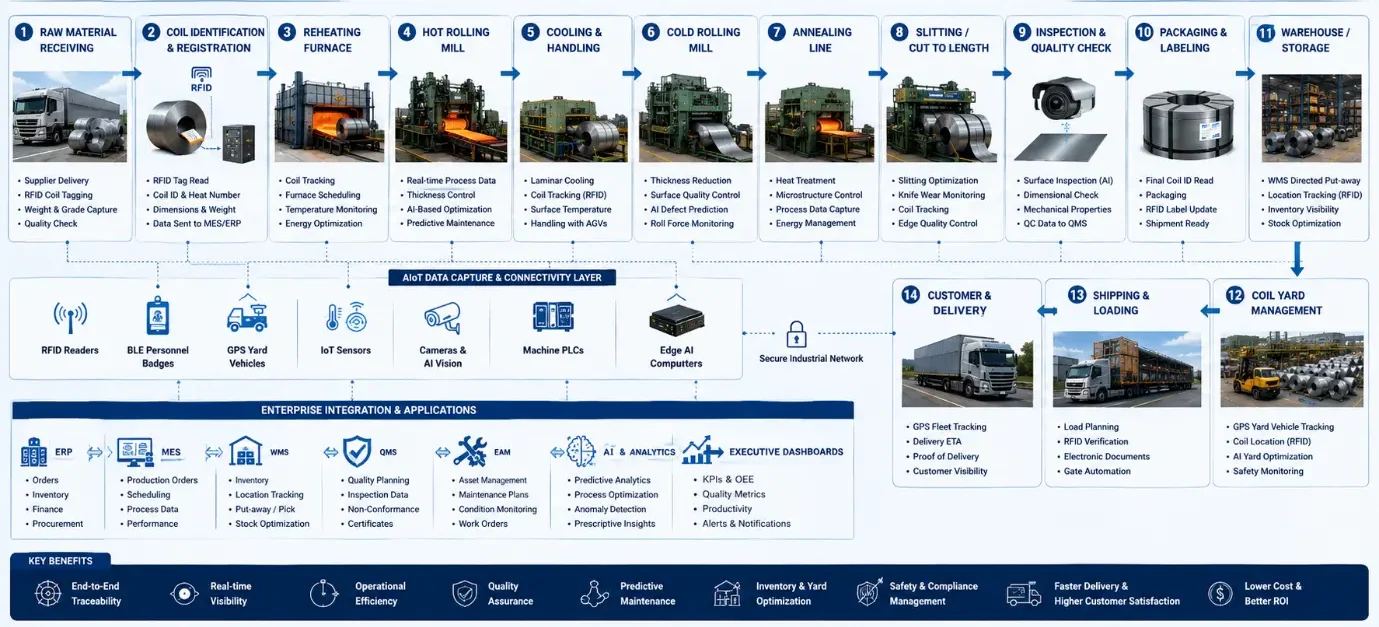
This workflow diagram shows the end-to-end movement of steel coils through a rolling mill, from raw material receiving to customer delivery. It demonstrates how RFID, BLE, GPS, Edge AI, ERP, MES, WMS, and quality management systems work together to provide real-time identification, traceability, operational visibility, and intelligent material flow across the production lifecycle.
Brief Description of Applications in Metal Forming & Rolling
AI software for coil handling and production supports a wide range of rolling operations where accurate identification and location information are essential for productivity, quality, and safety. Typical applications include:
These applications help manufacturers improve personnel accountability, coil identification, production flow visibility, inventory accuracy, and traceability while integrating with existing enterprise manufacturing software.
Personnel Access and Mill Floor Safety Analytics
Rolling mills are among the most demanding industrial environments. Personnel routinely work around reheating furnaces, roughing mills, finishing stands, coil downcoilers, overhead cranes, hydraulic systems, slitting equipment, automated transfer cars, and heavy mobile machinery. Maintaining awareness of worker locations and controlling access to hazardous production areas are essential for safe and efficient operations.
MetalProcess AI applies AI software to continuously evaluate identification and location events generated through RFID employee credentials, BLE worker badges, access control readers, and enterprise identity systems. Rather than simply recording entry and exit events, AI software correlates personnel movement with production schedules, work assignments, restricted zones, maintenance activities, and operational workflows.
This enables production supervisors and safety managers to understand how people interact with the manufacturing environment while reducing manual verification activities.
AI Personnel Location Analytics
Personnel location analytics provide continuous operational awareness across rolling facilities by evaluating movement patterns rather than isolated identification events. AI software helps determine whether employees, contractors, maintenance personnel, or visitors are located where they are expected to be during normal operations.
Typical capabilities include:
These capabilities improve coordination between production, maintenance, warehouse, and safety teams while reducing reliance on manual attendance records.
AI Restricted Zone Access Control
Certain areas within rolling facilities require strict access management because of elevated operational risks. Examples include furnace charging areas, rolling stands, coil transfer systems, crane maintenance systems, electrical substations, hydraulic equipment rooms, and maintenance lockout zones.
AI software evaluates access events together with operational context to determine whether entry is appropriate. Examples include:
Instead of relying solely on predefined rules, AI software continuously learns operational patterns and identifies activities that differ from normal production behavior, allowing supervisors to investigate potential safety concerns before they become operational problems.
AI Mill Floor Worker Safety
Worker safety benefits from understanding where personnel are located relative to active production operations. AI software combines identification information with production status to improve situational awareness across the facility. Examples include:
These analytical functions complement existing safety procedures and provide additional operational insight without changing established manufacturing workflows.
AI Access Credential Verification
Identity verification is more than validating whether a credential is active. AI software evaluates how credentials are used over time to identify patterns that may indicate operational issues or security concerns. Analytical functions include:
Production managers gain greater confidence that only authorized personnel are accessing production assets while simplifying compliance reporting and audit preparation.
AI Workflow for Identification, Location Intelligence, and Enterprise Decision Support in Rolling Mill Operations
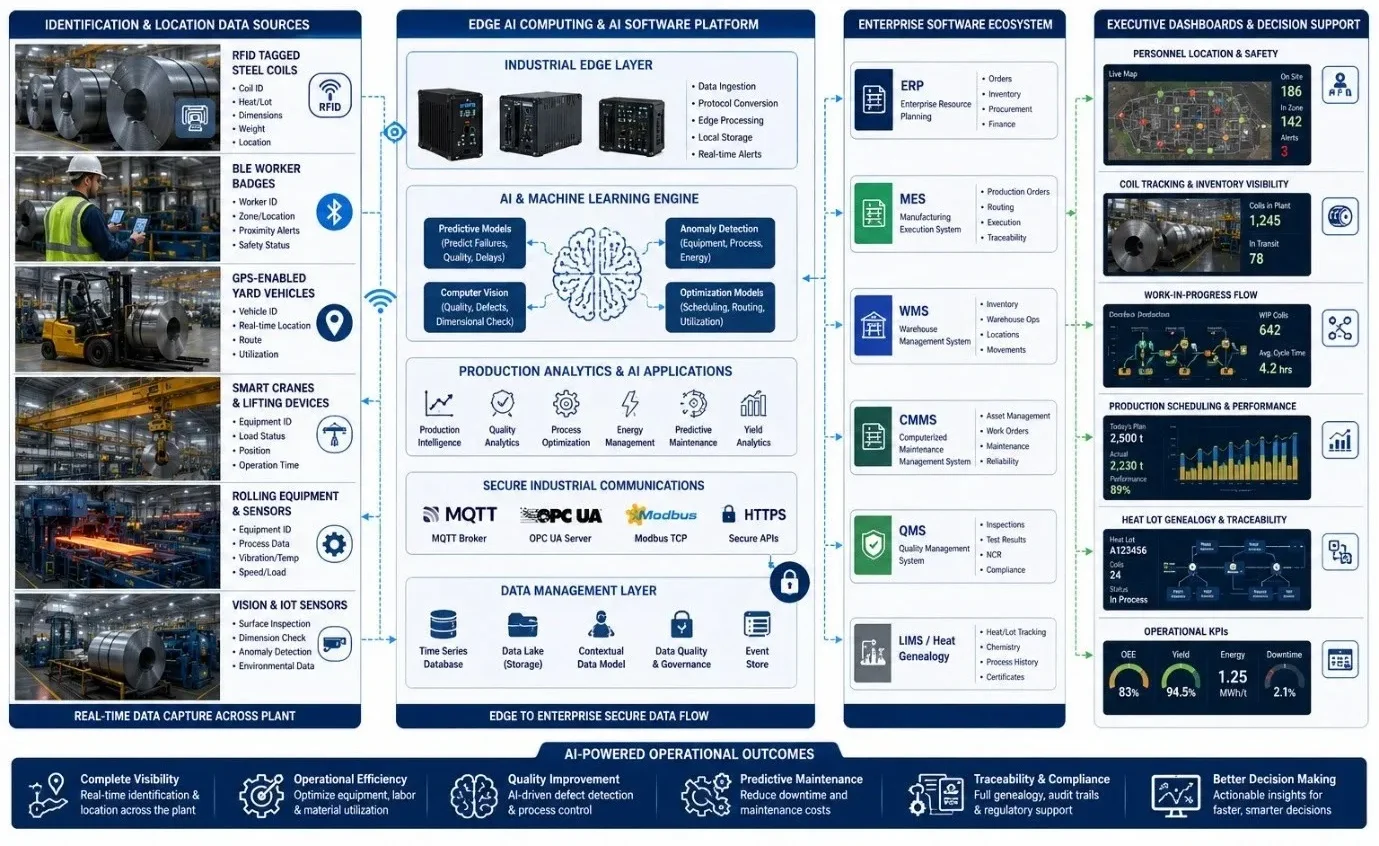
This enterprise workflow diagram represents how identification and location data from RFID-tagged steel coils, BLE personnel badges, GPS-enabled vehicles, cranes, and rolling equipment flows through edge AI, machine learning, production analytics, and secure industrial communication protocols. The processed information integrates with ERP, MES, WMS, CMMS, and QMS systems to deliver real-time operational intelligence, coil traceability, inventory visibility, production scheduling, heat lot genealogy, and executive performance dashboards for informed decision-making.
Coil and Work Roll Asset Utilization Analytics
Steel coils, aluminum coils, work rolls, backup rolls, transfer equipment, overhead cranes, forklifts, and specialized handling equipment represent significant operational assets within rolling facilities. Efficient utilization of these assets directly affects production throughput, inventory turnover, maintenance planning, and customer delivery performance.
MetalProcess AI analyzes identification and location information collected throughout production to improve visibility into how assets move, how frequently they are used, and how effectively they support manufacturing operations.
Rather than simply displaying asset locations, AI software evaluates movement history, utilization patterns, idle time, production assignments, and logistics activities to support better operational decisions.
AI Coil Asset Utilization Analytics
Every production coil follows a unique manufacturing journey from raw material receipt through rolling, inspection, storage, finishing, and shipment. AI software continuously evaluates coil movement and processing history to improve production visibility. Typical analytical capabilities include:
By understanding how coils move throughout the facility, production planners can identify unnecessary handling activities, reduce search time, and improve scheduling accuracy.
AI Work Roll Asset Analysis
Work rolls and backup rolls are essential production assets whose availability directly influences rolling schedules and product quality. AI software analyzes identification records and maintenance information to improve utilization planning. Typical capabilities include:
These functions help maintenance teams coordinate roll preparation while minimizing production interruptions.
Mobile Equipment Utilization
Forklifts, coil carriers, automated guided vehicles, transfer cars, and overhead cranes continuously support material movement across rolling operations. AI software evaluates utilization patterns to improve logistics efficiency. Analytical functions include:
Improved visibility enables supervisors to allocate equipment more effectively during changing production conditions.
Operational Benefits of Asset Analytics
Accurate asset utilization information supports numerous manufacturing objectives, including:
Because these capabilities are based primarily on identification and location technologies, organizations can improve operational performance while leveraging existing enterprise software and industrial communication infrastructure.
Raw Material and Finished Coil Inventory Forecasting
Rolling mills depend on accurate inventory information to maintain production continuity, optimize storage capacity, and satisfy delivery schedules. Raw materials such as slabs, billets, blooms, and coils must be available when scheduled for production, while finished coils must be staged efficiently for downstream processing or shipment. Even small inventory discrepancies can lead to production delays, unnecessary material handling, increased crane travel, and reduced equipment utilization.
MetalProcess AI applies AI software to identification and location data collected throughout rolling operations to improve inventory planning and forecasting. Rather than relying solely on periodic inventory counts or historical reports, AI continuously evaluates material movement, storage patterns, production consumption, and shipping activity to provide a more accurate representation of inventory status.
Because the software is driven primarily by RFID identification, BLE location services, GPS-enabled yard assets, and enterprise production data, inventory decisions are based on actual operational activity rather than manual assumptions.
AI Inventory Stock Optimization
Rolling facilities frequently store thousands of coils with different grades, dimensions, widths, thicknesses, customer orders, and production priorities. Efficient inventory organization reduces unnecessary material movement and improves production responsiveness. AI software evaluates inventory distribution across warehouses and coil yards by analyzing:
Production planners benefit from improved visibility into inventory conditions while warehouse personnel spend less time locating materials.
AI Raw Material Inventory Forecasting
Production schedules depend on maintaining sufficient raw material availability without creating excessive inventory carrying costs. AI software analyzes historical production demand together with current identification data to support forecasting activities such as:
Forecasting models continuously adapt as production schedules, customer demand, and material movement change throughout the manufacturing cycle.
AI Finished Coil Inventory Forecasting
Finished goods inventory represents completed production that is awaiting inspection, packaging, shipment, or customer pickup. Maintaining visibility into finished inventory improves customer service while reducing storage congestion. AI software supports:
This enables logistics teams to coordinate outbound shipments more effectively while improving overall inventory accuracy.
Operational Benefits of Inventory Analytics
Organizations implementing AI-driven inventory software commonly pursue improvements such as:
These capabilities help rolling operations align production, warehouse, and logistics activities using continuously updated identification information.
Work-in-Progress Flow Analytics for Tandem and Reversing Mills
Work-in-progress (WIP) represents materials actively moving through rolling operations but not yet completed. WIP visibility is particularly important in tandem mills, reversing mills, pickling lines, annealing lines, temper mills, slitting operations, and finishing processes where multiple production stages must remain synchronized.
Without accurate identification and location information, production planners may have limited visibility into material status, resulting in bottlenecks, unnecessary waiting time, or inefficient equipment utilization.
MetalProcess AI analyzes identification events generated throughout production to create a continuously updated view of work-in-progress movement across the rolling facility.
AI Work-in-Progress Flow Analytics
Rather than tracking production only at major process milestones, AI software evaluates how materials move between each production stage. This provides a detailed understanding of manufacturing flow while identifying opportunities for operational improvement. Typical analytical capabilities include:
These analytical functions provide production managers with greater operational awareness while reducing dependence on manual status updates.
AI Rolling Mill Throughput Prediction
Rolling throughput depends on coordinated movement of materials, personnel, and production assets. Small disruptions at one production stage may affect multiple downstream operations. AI software evaluates production activity to support throughput planning by analyzing:
By correlating identification events with production schedules, AI software helps estimate production capacity under changing operating conditions.
AI Production Bottleneck Detection
Production bottlenecks often develop gradually as work-in-progress accumulates at specific process stages. Traditional reporting methods may identify these conditions only after production efficiency has already declined. AI software continuously evaluates movement patterns to identify conditions such as:
Production supervisors receive actionable operational insight that supports faster corrective decisions while minimizing production disruptions.
Business Value of WIP Analytics
Improved work-in-progress visibility contributes to measurable operational improvements throughout rolling facilities. Potential benefits include:
AI software transforms identification and location information into practical operational guidance, allowing manufacturers to improve workflow efficiency without fundamentally changing existing production processes.
Coil Genealogy and Heat Lot Traceability Analytics
Product traceability is a fundamental requirement in metal forming and rolling operations. Every finished coil must be associated with its originating heat lot, casting sequence, rolling schedule, inspection records, and downstream processing history. Customers in automotive, construction, appliance manufacturing, energy, aerospace, and industrial equipment industries frequently require documented material genealogy to demonstrate compliance with contractual specifications and quality requirements.
MetalProcess AI analyzes identification and location data generated throughout production to create a comprehensive digital history for every coil. Rather than relying solely on manual records or disconnected production logs, AI software correlates material movement with production events, quality documentation, and enterprise records to provide a continuous chain of custody.
AI Coil Genealogy
Each coil receives a unique digital identity that follows it throughout production. AI software associates this identity with every significant manufacturing event, allowing engineers and quality teams to reconstruct the complete production history. Typical analytical capabilities include:
This information supports quality investigations, customer documentation, and operational reporting while reducing manual data collection.
AI Heat Lot Traceability Analytics
Heat lot traceability links finished material back to the original melt and casting process. Maintaining this relationship throughout rolling operations improves quality management and simplifies compliance with customer and industry requirements. AI software supports:
Because traceability information is automatically correlated with identification events, organizations can reduce administrative effort while improving record accuracy.
AI Metal Forming Quality Analytics
Quality outcomes are influenced by production routing, handling practices, equipment utilization, and processing consistency. AI software evaluates production history together with identification records to support continuous quality improvement. Examples include:
These capabilities provide engineers with greater visibility into production conditions without replacing existing quality management systems.
How AI Software Differs from IoT Hardware and Integration Layers
AI software, IoT hardware, and enterprise integration each perform different functions within an AIoT solution. Understanding these differences helps organizations develop deployment strategies that maximize operational value.
AI software analyzes operational information and converts identification events into recommendations, forecasts, and decision support. RFID tags, BLE badges, GPS devices, and other identification technologies collect the information used by AI software, while enterprise integration connects operational data with business systems.
Applications in Metal Forming & Rolling
MetalProcess AI supports AI-driven operational decision making across diverse rolling and forming environments where accurate identification and location information are essential. Typical application areas include:
Each deployment is configured around existing production workflows, enabling organizations to improve operational visibility while preserving established manufacturing processes.
Industry Experience Behind MetalProcess AI
MetalProcess AI is created within Aperture Venture Studio with support from GAO, drawing on nearly two decades of practical IoT experience across industrial manufacturing environments. This experience includes thousands of successful IoT deployments and customer engagements that have helped shape practical approaches for identification, location, and enterprise integration within demanding production facilities.
Research and development investments, comprehensive quality assurance practices, and remote and onsite technical support contribute to reliable implementation methodologies. The organization is led by Ph.D. professionals and supported by experienced engineers, technical specialists, and strategic industry partners. Experience gained through projects with Fortune 500 manufacturers, leading research organizations, universities, and government agencies in the United States and Canada provides a strong foundation for developing scalable AI and IoT solutions for metal forming and rolling operations.
Contact Us