
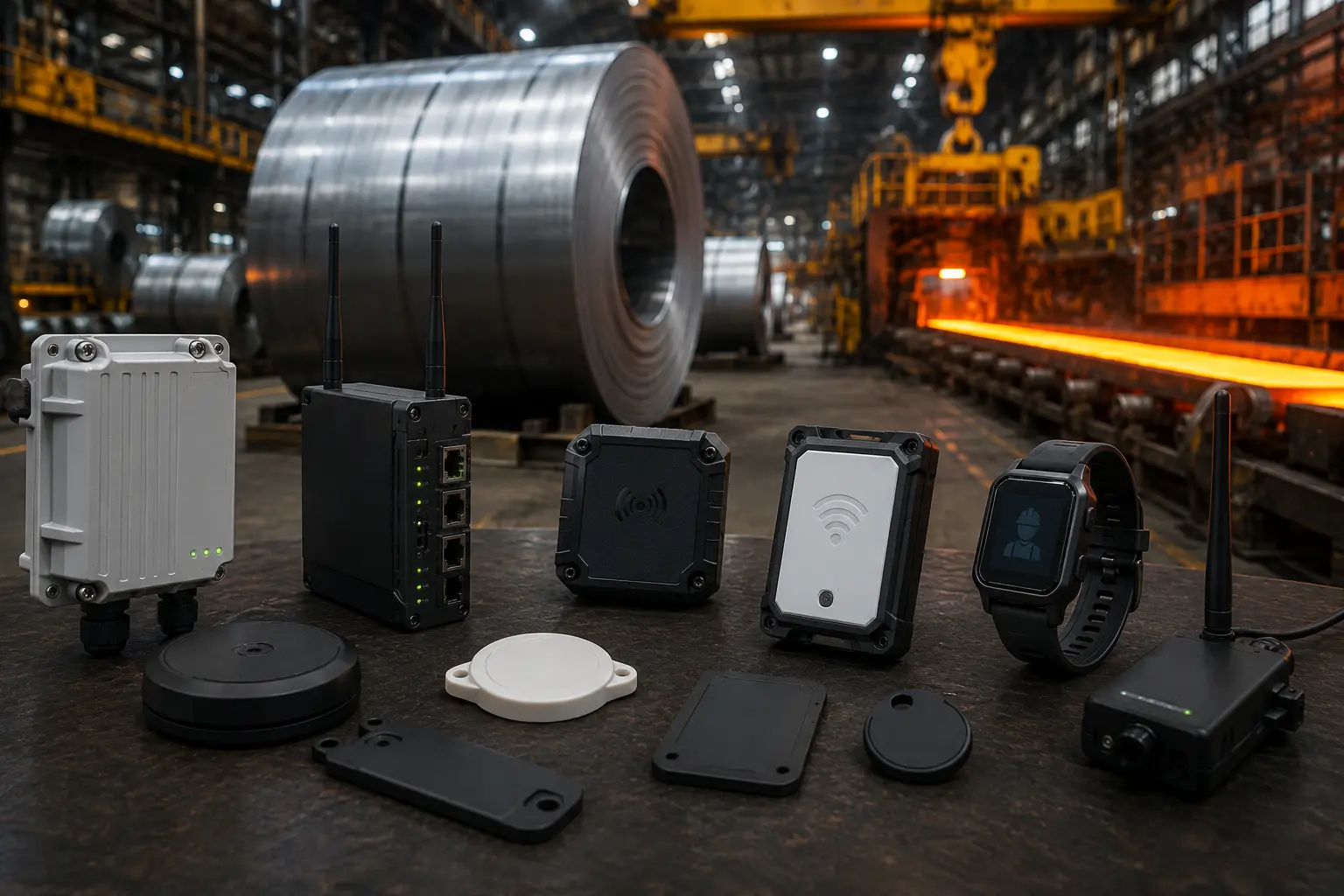
AI and IoT Hardware Technologies for Metal Forming & Rolling
Hardware Built to Survive Heat, Scale, and Steel
RFID Coil Tags, BLE Worker Badges, and Location Beacons Paired with AI for Rolling Mill Identification and Tracking
Metal forming and rolling facilities operate under some of the most demanding industrial conditions found in manufacturing. Hot rolling mills expose equipment to elevated temperatures, scale accumulation, vibration, moisture, heavy mechanical impact, and continuous material movement. Cold rolling mills, coil yards, finishing lines, and shipping operations present different operational challenges, requiring reliable identification technologies capable of maintaining performance across diverse production environments.
MetalProcess AI provides identification and location hardware engineered specifically for rolling operations. The hardware supports reliable identification of coils, work rolls, personnel, mobile equipment, and finished products while supplying trusted operational data for AI software and enterprise manufacturing systems.
Artificial Intelligence of Things, commonly called AIoT or AI and IoT, combines artificial intelligence with IoT devices, sensors, connected equipment, and industrial systems. AIoT solutions may also use Industrial AI, Edge AI, machine learning, computer vision, and, in autonomous applications, Physical AI. Within rolling operations, identification hardware supplies the operational data required for AI software to support worker safety, asset utilization, inventory management, work-in-progress visibility, and material traceability.
Unlike enterprise software, physical hardware performs direct identification and location functions. RFID tags uniquely identify production coils and reusable assets. BLE badges associate personnel with authorized operational areas. GPS devices provide outdoor asset location across coil yards and transportation operations. Industrial readers and gateways collect identification events and securely transfer information to IoT software and enterprise applications.
Selecting the correct hardware is essential because performance depends not only on communication technology but also on environmental durability, installation location, read distance, material characteristics, and operational workflow.
Overview of AI and IoT Hardware for Rolling Operations
Rolling facilities use multiple identification technologies because no single communication method is suitable for every operational requirement.
RFID technologies provide highly reliable identification of steel coils, aluminum coils, work rolls, pallets, lifting fixtures, and reusable production assets. BLE devices support personnel identification and proximity-based location within production areas. GPS devices provide asset visibility across outdoor storage yards and transportation routes. Industrial edge computers and communication gateways coordinate information exchange between field hardware and enterprise software.
Together, these technologies create the physical foundation supporting AI and IoT solutions throughout the rolling process.
Rather than operating independently, these identification technologies function together to establish continuous digital identities for personnel, production assets, and finished products throughout manufacturing and logistics operations.
Reliable hardware selection contributes directly to accurate identification, improved inventory visibility, consistent traceability, and dependable enterprise data collection.
Enterprise AI and IoT Hardware System for Rolling Mill Operations
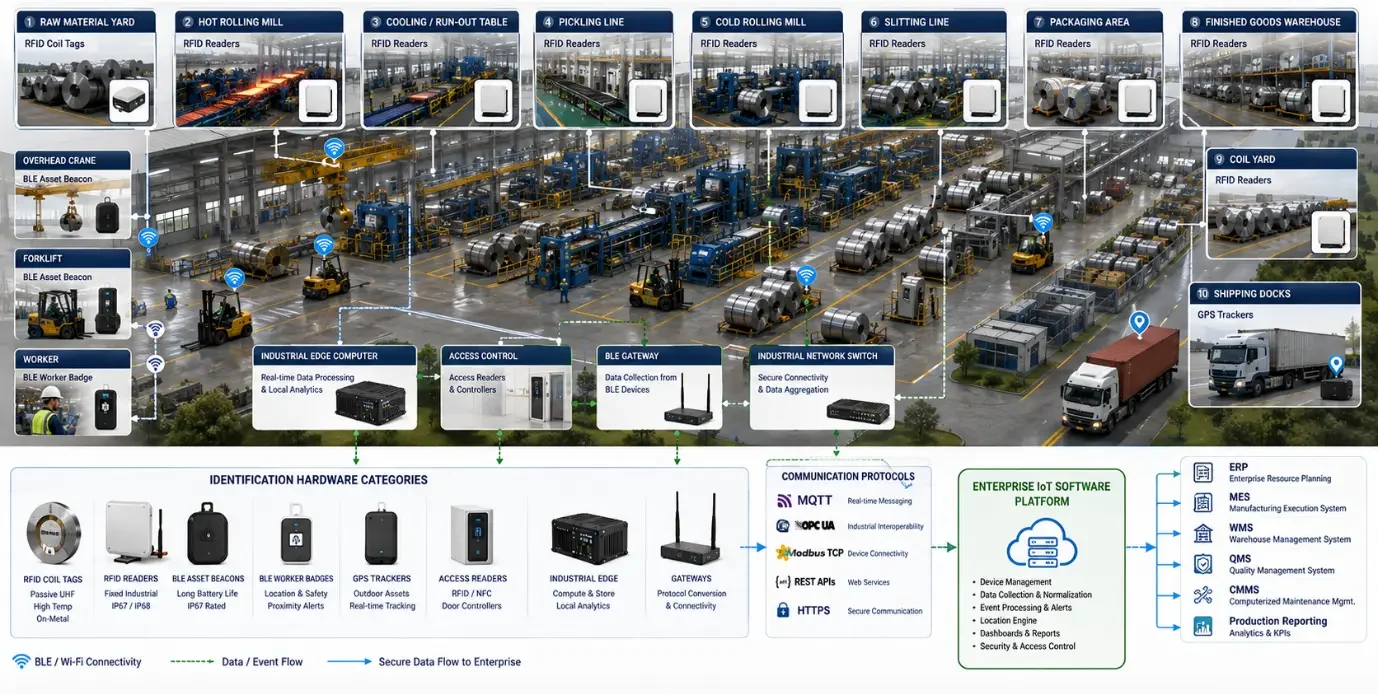
This enterprise hardware overview diagram represents the identification technologies deployed across a modern rolling mill, including RFID coil tags, RFID readers, BLE worker badges, BLE asset beacons, GPS trackers, industrial edge computers, access control readers, and communication gateways. It demonstrates how identification data from production equipment, warehouses, coil yards, forklifts, cranes, and shipping operations flows into enterprise IoT software to support real-time visibility, asset tracking, traceability, and manufacturing system integration.
Physical Identification Devices for Coils, Rolls, and Personnel
Reliable AI and IoT solutions begin with dependable physical identification devices. Every digital workflow depends on hardware capable of consistently identifying people, production assets, and materials despite demanding industrial conditions.
MetalProcess AI supports a broad portfolio of industrial-grade identification hardware selected specifically for rolling operations rather than general-purpose commercial environments. Hardware is chosen according to application requirements, read distance, installation method, environmental exposure, maintenance considerations, and compatibility with enterprise software.
RFID Coil Tags
Steel and aluminum coils move through multiple production stages before shipment. RFID coil tags provide each coil with a persistent digital identity that remains associated with the material throughout its manufacturing lifecycle. Typical RFID coil tag applications include:
Industrial RFID tags used for rolling operations are designed to withstand demanding manufacturing conditions while maintaining reliable identification performance around metallic materials.
RFID Tags for Production Assets
Reusable production equipment also requires accurate identification to support maintenance records, utilization tracking, and operational documentation. Common tagged assets include:
Assigning unique digital identities to these assets simplifies asset management and supports accurate operational records throughout the facility.
BLE Worker Badges
BLE badges provide secure personnel identification while supporting workforce location applications in designated operational areas. Typical deployment locations include:
These identification devices work together with BLE gateways and enterprise software to maintain accurate personnel location records and authorized access histories.
AI and RFID for Coil and Access Identification
High-temperature rolling operations demand reliable identification technologies that continue to perform despite radiant heat, mill scale, vibration, oil, dust, and constant equipment movement. AI and RFID work together to provide dependable identification for steel coils, work rolls, lifting equipment, material carriers, and authorized personnel throughout rolling facilities.
RFID uniquely identifies physical objects using electronic tags attached to coils, roll chocks, pallets, containers, lifting fixtures, and employee credentials. Fixed RFID readers positioned at production transitions automatically capture identification events without requiring manual barcode scanning or paperwork. AI software evaluates these identification events, correlates them with production schedules, verifies movement sequences, detects anomalies, and supports operational decision-making.
Rather than relying on manual recording, operators gain automated confirmation whenever coils enter reheating furnaces, exit roughing stands, move into finishing mills, arrive at coil yards, or enter shipping preparation areas. Personnel identification follows similar principles through RFID-enabled access credentials that verify worker authorization before granting entry into restricted production areas.
RFID Coil Identification
Large steel coils often pass through multiple production stages before shipment. Maintaining a continuous digital identity throughout these stages helps reduce handling errors while supporting inventory visibility and production planning. Typical RFID coil identification applications include:
AI software continuously compares expected coil movements with actual identification events. Unexpected routing, duplicate handling, or missing production steps can be identified quickly for operator review.
RFID Access Credential Verification
Rolling mills contain numerous controlled work areas that require strict personnel authorization because of heavy machinery, molten materials, overhead cranes, hydraulic systems, and automated equipment. RFID employee credentials support secure identification by allowing authorized workers to access designated operational zones while maintaining comprehensive audit records. Common access control applications include:
AI software evaluates credential information together with operational context. Rather than simply confirming badge validity, AI can recognize unusual access behavior, repeated unauthorized attempts, unexpected shift movements, or abnormal personnel activity patterns that may require additional investigation.
AI Enhances RFID Identification
RFID hardware captures identification events. AI transforms those events into operational knowledge. Examples include:
This distinction is important throughout AIoT deployments. RFID provides dependable identification while AI interprets historical and real-time identification data to improve operational performance.
AI and BLE for Personnel Location and Asset Proximity
Rolling mills span extensive production buildings, outdoor storage yards, maintenance facilities, shipping areas, and overhead crane systems. Workers, maintenance crews, contractors, mobile equipment, and valuable assets continuously move throughout these environments. Knowing where personnel and equipment are located improves operational coordination while supporting worker safety.
Bluetooth Low Energy (BLE) badges and location beacons provide continuous indoor location awareness without requiring manual interaction. BLE identification complements RFID by providing ongoing location updates instead of capturing identification only at fixed checkpoints.
BLE worker badges support applications such as:
BLE asset beacons extend similar capabilities to valuable operational equipment. Common tracked assets include:
AI software evaluates historical location patterns together with current asset availability to recommend improved equipment utilization, reduce search time, and identify inefficient movement patterns.
Asset Proximity Analysis
Many rolling operations involve coordinated movement between cranes, forklifts, transport vehicles, work rolls, and production equipment. BLE proximity information allows AI software to identify relationships between nearby assets and operational activities. Typical analytical capabilities include:
Rather than simply displaying equipment locations, AI software continuously evaluates movement history to identify opportunities for operational improvement.
Personnel Location Analytics
Personnel movement data provides valuable operational insights beyond emergency response. AI software may analyze:
These insights help rolling facilities improve productivity while maintaining worker accountability and operational safety without relying on manual reporting procedures.
AI and LoRaWAN for Coil Yard Location Tracking
Large rolling facilities frequently operate outdoor coil yards where thousands of finished coils, semi-finished products, slabs, billets, blooms, work rolls, and material carriers are stored before additional processing or shipment. These storage areas often span hundreds of thousands of square feet, making manual asset location inefficient and time consuming. AI and LoRaWAN support long-range location awareness across expansive outdoor environments while minimizing communication infrastructure requirements.
LoRaWAN provides reliable wireless communication for location beacons and industrial identification devices distributed throughout large coil storage yards, staging areas, rail sidings, truck loading zones, and satellite storage locations. Combined with AI software, LoRaWAN helps maintain continuous visibility of critical assets without requiring dense reader installations.
Unlike RFID, which captures identification at specific checkpoints, LoRaWAN supports broader yard-wide communication. AI software correlates location updates with production schedules, shipment priorities, storage assignments, and inventory records to improve operational efficiency.
Outdoor Coil Yard Asset Location
Steel coils are frequently relocated multiple times before shipment because of production sequencing, customer priorities, storage optimization, or transportation schedules. Losing track of a single high-value coil can result in unnecessary crane movements, loading delays, production interruptions, and increased labor costs. AI and LoRaWAN support outdoor asset visibility by helping operations teams:
AI software continuously evaluates asset locations and recommends more efficient storage arrangements based on shipment schedules, customer priorities, production status, and historical handling patterns.
Yard Operations Optimization
Rolling facilities often balance multiple priorities simultaneously, including production throughput, shipping deadlines, crane availability, truck arrivals, and rail logistics. AI uses LoRaWAN location information together with production and inventory data to improve overall yard operations. Examples include:
Rather than simply displaying where coils are located, AI software transforms location information into operational recommendations that improve productivity and reduce unnecessary material handling.
AI and LoRaWAN for Intelligent Steel Coil Yard Location Tracking
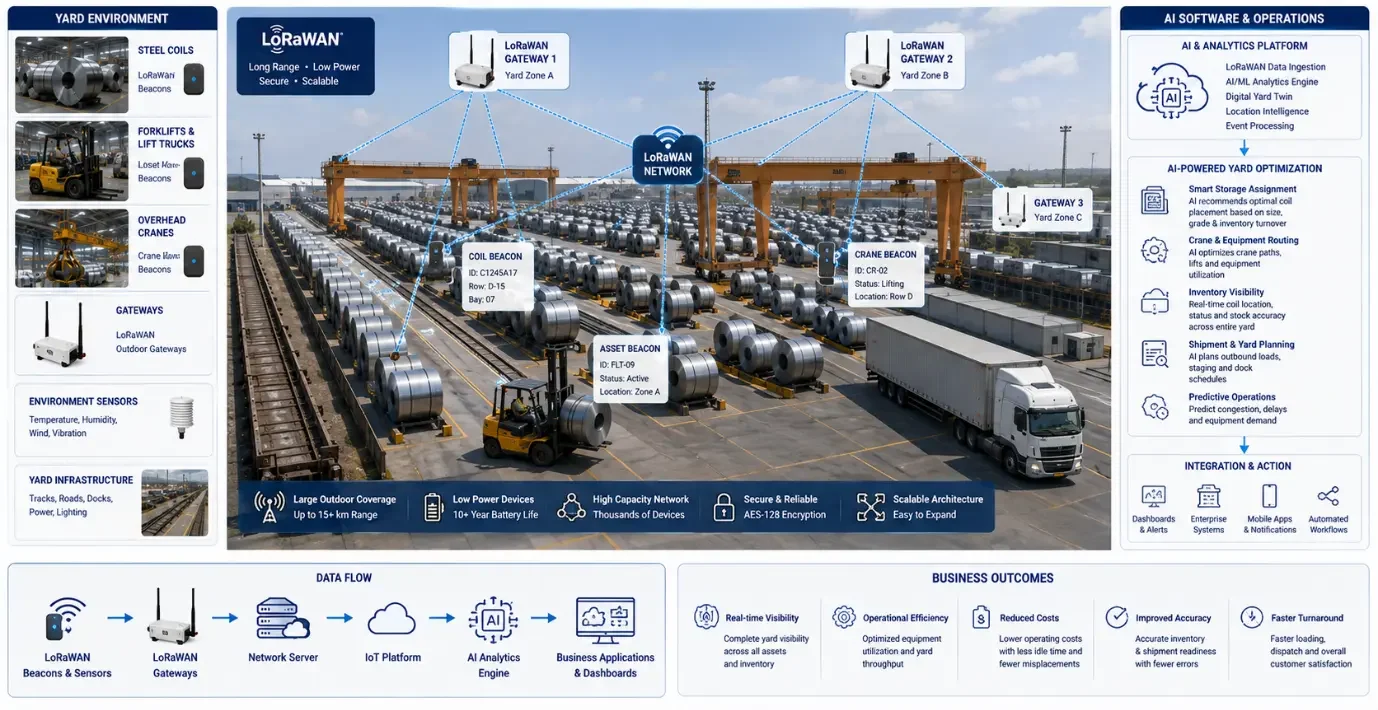
This enterprise diagram represents how LoRaWAN enables AI-powered location tracking across a large outdoor steel coil yard. It shows location beacons on steel coils and mobile equipment communicating through LoRaWAN gateways to AI software, which optimizes storage allocation, crane routing, shipment preparation, inventory visibility, and outbound logistics while providing real-time operational intelligence across the yard.
AI and GPS for Outbound Coil and Shipment Tracking
Once finished coils leave the rolling facility, maintaining shipment visibility becomes essential for customer service, transportation coordination, inventory reconciliation, and supply chain planning. GPS supports location awareness during transportation, while AI software analyzes shipment progress and logistics performance throughout the delivery process.
GPS beacons installed on transport assets or shipping equipment provide location updates as coils move between manufacturing facilities, service centers, distribution yards, ports, rail terminals, and customer sites. AI software combines shipment location with order status, transportation schedules, estimated arrival times, and inventory records to provide accurate operational visibility.
Outbound Shipment Visibility
GPS-enabled tracking helps logistics teams monitor coil movements beyond the factory gate while reducing manual shipment inquiries. Typical applications include:
AI software continuously evaluates shipment progress against expected transit plans and identifies delays, routing deviations, or scheduling conflicts that may affect customer commitments.
Logistics Performance Analysis
GPS information becomes significantly more valuable when combined with AI analytics. AI software can identify:
These analytical capabilities help logistics managers improve transportation planning while supporting more accurate customer communication and operational forecasting.
Hardware Durability Requirements for High-Heat Mill Environments
Metal forming and rolling operations present some of the most demanding industrial conditions for identification and location hardware. High ambient temperatures, radiant heat, mill scale, vibration, mechanical shock, heavy equipment movement, lubricants, moisture, metallic interference, and abrasive dust all influence hardware selection and long-term reliability.
Selecting hardware based solely on communication technology is rarely sufficient. Successful deployments require devices engineered specifically for steel production environments and matched to each operational area.
Because every production area presents different environmental conditions, many facilities deploy a combination of RFID, BLE, LoRaWAN, and GPS technologies rather than relying on a single identification method. AI software integrates identification and location data from these technologies into a unified operational view, allowing rolling mills to improve personnel safety, asset visibility, inventory management, work-in-progress tracking, and traceability across the entire production lifecycle.
Applications Across Metal Forming and Rolling Operations
Identification and location technologies are most valuable when applied to specific production workflows. MetalProcess AI supports AI and IoT deployments across multiple rolling environments by combining RFID, BLE, LoRaWAN, GPS, Edge AI, machine learning, and computer vision with industrial identification hardware and enterprise software.
Hot Rolling Mills
Hot rolling operations involve reheating furnaces, roughing stands, finishing stands, cooling tables, coilers, and heavy material handling equipment. AI and IoT help maintain accurate identification of coils, personnel, and production assets as materials move through high-temperature processes.
- Coil identification before furnace charging
- Personnel access control in restricted production zones
- Crane-assisted coil movement verification
- Finished coil identification before storage
- Work roll identification and lifecycle management
- Production routing verification
Cold Rolling Mills
Cold rolling facilities demand precise production sequencing, inventory accuracy, and product genealogy. Reliable identification improves production planning while reducing manual data collection.
- Incoming coil verification
- Intermediate process identification
- Inventory location management
- Finished product identification
- Order fulfillment validation
- Production history documentation
Coil Yard Operations
Outdoor coil storage yards benefit from continuous visibility of finished inventory, staging areas, and outbound shipments.
- Coil location management
- Storage optimization
- Crane dispatch coordination
- Truck loading verification
- Rail shipment preparation
- Inventory reconciliation
Forming Press Lines
Press shops and forming operations require accurate material identification throughout stamping and forming processes.
- Material verification
- Die change authorization
- Personnel access management
- Work-in-progress identification
- Production routing validation
- Finished component traceability
Finishing and Slitting Lines
Secondary processing operations often determine final product quality and customer-specific requirements.
- Coil identity preservation
- Slitting order verification
- Packaging validation
- Shipment preparation
- Inventory accuracy
- Customer order confirmation
Selecting the Right Identification Technology
Successful AIoT deployments rarely depend on a single wireless technology. Instead, rolling facilities typically combine multiple identification and location methods, selecting each according to operational requirements, environmental conditions, and asset movement patterns.
The selection process should consider:
A layered approach allows each technology to perform the role for which it is best suited. RFID excels at point-of-process identification, BLE provides continuous personnel and nearby asset location, LoRaWAN extends visibility across expansive outdoor storage areas, and GPS follows outbound shipments after they leave the facility. AI software correlates data from these sources to support operational decisions across the production lifecycle.
Engineering Experience Behind MetalProcess AI
MetalProcess AI was created within Aperture Venture Studio with support from GAO, drawing on more than two decades of industrial IoT experience. The software, hardware recommendations, and deployment methodologies reflect knowledge gained from thousands of customer engagements and successful industrial identification projects.
Research and development efforts are supported by rigorous quality assurance processes, experienced engineering teams, and remote or onsite technical support. The organization is led by Ph.D. professionals from leading universities and has built relationships with industry experts, technology partners, and investors dedicated to advancing industrial AI and IoT solutions.
Over the years, the underlying expertise has supported Fortune 500 manufacturers, advanced research organizations, prestigious universities, and government agencies throughout the United States and Canada. This practical experience guides hardware selection, deployment planning, enterprise integration, and long-term operational support for metal forming and rolling facilities.
Learn More About MetalProcess AI
Whether your operation focuses on hot rolling, cold rolling, coil storage, press forming, or finishing lines, MetalProcess AI provides the technologies and engineering expertise required to build reliable AIoT identification and location solutions for demanding steel manufacturing environments. Explore the remaining sections of our website to learn more about:
Applicable U.S. and Canadian Standards and Regulations for AI and IoT in Metal Forming & Rolling
The following standards and regulations are among the most relevant for AI-enabled personnel tracking, access control, asset tracking, inventory management, work-in-progress visibility, and traceability solutions used in metal forming and rolling operations.
Occupational Safety and Machine Safety
Functional Safety and Industrial Automation
RFID, BLE, Wireless Communications, and Identification
Cybersecurity and Information Security
Quality Management and Traceability
Enterprise Systems and Data Exchange
Leading Companies Serving AI and IoT for Metal Forming & Rolling
The following organizations are among the leading technology providers supporting AI-enabled personnel tracking, access control, RFID identification, asset tracking, inventory visibility, work-in-progress management, coil genealogy, industrial automation, and enterprise integration for metal forming and rolling facilities.
Industrial Automation
RFID and Industrial Identification
BLE and Industrial Location Solutions
LoRaWAN and Industrial Connectivity
GPS and Fleet Tracking
Computer Vision and Industrial AI
MES, ERP, and Manufacturing Software
Industrial Networking and Edge Computing
Why MetalProcess AI
MetalProcess AI applies AI and IoT to identification and location challenges across metal forming and rolling operations, with emphasis on personnel tracking, access control, coil identification, asset tracking, inventory visibility, work-in-progress flow, and material traceability. Rather than focusing on general industrial software, the solution is designed around the operational realities of rolling mills, coil yards, forming lines, slitting operations, and steel logistics.
Built within Aperture Venture Studio with support from GAO, MetalProcess AI reflects more than two decades of industrial IoT experience gained through thousands of customer engagements and successful projects across primary metals manufacturing. Its engineering approach combines practical deployment knowledge, rigorous quality assurance, and technical expertise from Ph.D.-led teams to help manufacturers implement reliable AIoT solutions that integrate with existing ERP, MES, WMS, CMMS, and industrial control systems.
Organizations ranging from Fortune 500 manufacturers and leading research institutions to universities and government agencies have benefited from the engineering experience behind MetalProcess AI. This foundation enables manufacturers to deploy identification and location solutions that improve workforce accountability, asset utilization, inventory accuracy, production flow visibility, and coil genealogy while supporting regulatory compliance, operational reliability, and long-term scalability in demanding metal forming and rolling environments.
Case Studies
Case Study 1: Pittsburgh, Pennsylvania
AI and IoT for Coil Tracking, Worker Location, and Rolling Mill Asset Management
A large metal forming and rolling facility operating multiple hot rolling and cold rolling lines experienced increasing production delays caused by manual coil identification, limited visibility of work roll movements, restricted access control challenges, and inconsistent inventory records across the coil yard. Thousands of steel coils moved daily between reheating furnaces, roughing mills, finishing mills, inspection stations, slitting lines, and shipping areas. Manual data entry created discrepancies between physical coil locations and ERP records, reducing production scheduling accuracy and increasing crane search times.
MetalProcess AI worked together with GAO Tek Inc. and GAO RFID Inc. to design and deploy an AI and IoT solution focused primarily on identification and location rather than sensing technologies. The implementation emphasized RFID-based coil identification, BLE personnel location, controlled access management, AI-assisted production analytics, and enterprise software integration.
Problem
Production supervisors lacked real-time visibility into coil movement throughout the rolling process. Forklift operators frequently searched for misplaced coils while overhead crane operators depended upon radio communications instead of verified digital locations.
Several operational challenges existed.
Rolling mill operations demanded continuous material movement under elevated temperatures while maintaining accurate identification from slab receipt through finished coil shipment.
Solution
MetalProcess AI implemented an enterprise AI and IoT software solution using multiple identification technologies integrated into existing production software.
GAO RFID Inc. supplied industrial UHF RFID readers, high-temperature RFID coil tags, RFID antennas, reader modules, and RFID accessories suitable for rolling mill environments. RFID tags remained associated with individual coils throughout multiple production stages while fixed readers automatically captured movement at transfer locations.
GAO Tek Inc. provided BLE gateways, BLE worker badges, BLE beacons, industrial edge computing equipment, GPS IoT tracking devices for outbound logistics, and biometric access devices supporting controlled mill entry.
The deployment included:
Artificial intelligence analyzed identification events rather than environmental measurements. AI software continuously evaluated:
The software generated recommendations whenever production flow deviated from expected routing.
Our engineering teams from GAO Tek Inc. assisted with RFID reader placement studies while GAO RFID Inc. supported antenna selection, tag validation, and interference testing suitable for high-heat steel production. We coordinated enterprise software integration while minimizing production interruptions.
Result
The deployment produced measurable operational improvements.
The most significant operational outcome was a 58% reduction in average coil search time, allowing crane operators and production planners to locate finished material much more efficiently.
Lessons Learned
Identification technology performs best when RFID read zones are engineered around actual material flow rather than building layout. Rolling mills contain dense steel structures that require careful antenna orientation and validation before full deployment. Early coordination among production, maintenance, and IT teams substantially reduces commissioning time.
Case Study 2: Gary, Indiana
AI and RFID Supporting Work Roll Management, Access Control, and Coil Inventory Visibility
A high-volume steel rolling operation producing structural steel coils and sheet products sought to improve visibility across multiple production buildings, storage yards, and outbound logistics areas. Manual tracking methods made it difficult to determine work roll availability, finished coil locations, and contractor access status during simultaneous maintenance activities.
MetalProcess AI partnered with GAO Tek Inc. and GAO RFID Inc. to implement an enterprise AI and IoT solution emphasizing RFID identification, BLE location awareness, inventory management, personnel accountability, and production workflow optimization.
Problem
The facility processed thousands of coils each week through hot rolling, pickling, cold reduction, annealing, temper rolling, inspection, slitting, and packaging operations. Existing operational issues included:
Production planning depended heavily upon manual reporting rather than continuously updated identification data.
Solution
MetalProcess AI designed a software solution integrating AI with enterprise identification technologies.
GAO RFID Inc. supplied:
These products supported automatic identification of steel coils, work rolls, production containers, and shipping units.
GAO Tek Inc. deployed:
BLE badges continuously supported personnel location across rolling buildings, maintenance workshops, coil storage areas, and shipping operations. Access credential software validated worker authorization before permitting entry into hazardous production zones.
Artificial intelligence evaluated identification events collected from RFID and BLE infrastructure to generate production recommendations based on:
Instead of depending upon manual reports, supervisors viewed continuously updated software dashboards built from verified identification events.
GAO Tek Inc. engineering specialists assisted with industrial wireless planning, reader validation, enterprise software connectivity, and deployment sequencing. GAO RFID Inc. provided hardware configuration support, RFID performance testing, and commissioning assistance throughout implementation.
The completed solution integrated with existing ERP software, manufacturing execution software, warehouse software, maintenance software, and shipping management software while preserving established production workflows.
Result
Operational performance improved across multiple departments.
The most significant measurable improvement was a greater than 99% finished coil identification accuracy, significantly reducing manual verification before shipment.
Lessons Learned
Rolling facilities benefit most when identification standards are established before deployment begins. Consistent RFID tag placement, standardized naming conventions, and disciplined integration with ERP software simplify long-term maintenance while improving AI software recommendations. Successful implementations also require collaboration between production engineering, maintenance teams, and information technology personnel to maintain reliable identification throughout the entire coil lifecycle.
Case Study 3: Birmingham, Alabama
AI and IoT for Coil Genealogy, Work-in-Progress Tracking, and Finishing Line Asset Visibility
A metal forming and rolling facility specializing in cold rolled steel coils, galvanized sheet, slit coils, and value-added finishing products required greater visibility across its tandem mill, annealing operations, temper mill, slitting lines, and finished goods warehouse. Although ERP and manufacturing execution software managed production orders, personnel still relied heavily on manual barcode scans, paper travelers, and visual confirmation to identify coil locations and production status.
MetalProcess AI worked with GAO Tek Inc. and GAO RFID Inc. to implement an enterprise AI and IoT solution centered on identification and location technologies. The project focused on RFID coil identification, BLE personnel location, access credential verification, AI-assisted work-in-progress analysis, and digital genealogy throughout rolling and finishing operations.
Problem
Production scheduling became increasingly difficult because multiple coils with similar dimensions and grades often occupied nearby storage positions awaiting downstream processing. Operational challenges included:
The organization required continuous identification of every production unit without interrupting normal rolling operations.
Solution
MetalProcess AI designed and integrated an AI and IoT software solution that combined RFID identification, BLE location services, AI analytics, and enterprise software connectivity.
GAO RFID Inc. supplied:
Each production coil received a durable RFID identifier linked to production orders, heat numbers, rolling schedules, inspection records, and shipping documentation. Fixed RFID readers automatically captured movement between process stages without requiring manual scans.
GAO Tek Inc. supplied:
BLE infrastructure provided continuous personnel location throughout production buildings, maintenance areas, warehouse zones, shipping docks, and restricted equipment locations. AI software evaluated identification events collected from RFID readers and BLE gateways to improve operational decision support.
AI software continuously analyzed:
Our engineering teams performed RFID site surveys, antenna optimization, enterprise software integration, commissioning, and production validation. GAO Tek Inc. assisted with industrial networking, edge computing deployment, and access credential configuration, while GAO RFID Inc. optimized RFID hardware performance for steel-intensive production environments.
The completed solution exchanged identification information with ERP software, manufacturing execution software, warehouse management software, maintenance management software, and production scheduling applications.
Result
The deployment significantly improved production visibility throughout finishing operations.
The most significant measurable outcome was a 42% reduction in work-in-progress search and verification time, allowing production planners to schedule downstream operations more efficiently while reducing unnecessary crane movements.
Lessons Learned
Digital genealogy is most effective when RFID identification begins before the first rolling operation and continues through every downstream production stage. Consistent tag placement procedures and standardized identification rules simplify AI software analysis while improving long-term production traceability.
Case Study 4: Hamilton, Ontario
AI and IoT for Personnel Accountability, Coil Yard Management, and Outbound Shipment Verification
A Canadian steel processing and rolling operation required improved visibility across outdoor coil yards, indoor warehouses, shipping facilities, maintenance workshops, and administrative areas. The organization managed large inventories of finished coils serving automotive, appliance, construction, and industrial manufacturing customers.
Manual inventory validation, contractor access verification, and shipment preparation created unnecessary delays, particularly during peak production periods when multiple cranes and transport vehicles operated simultaneously.
MetalProcess AI collaborated with GAO Tek Inc. and GAO RFID Inc. to deploy an AI and IoT solution emphasizing identification, location, asset visibility, and enterprise software integration throughout rolling mill operations.
Problem
Several production and logistics activities depended upon manual confirmation. Operational concerns included:
Management required a software solution capable of improving operational awareness while integrating with existing enterprise software.
Solution
MetalProcess AI implemented a comprehensive AI and IoT solution based on RFID identification, BLE personnel location, GPS shipment visibility, and AI-assisted operational analytics.
GAO RFID Inc. supplied:
RFID readers automatically identified finished coils as overhead cranes transferred material between storage locations, staging areas, inspection stations, and shipping lanes.
GAO Tek Inc. supplied:
BLE worker badges supported personnel accountability throughout production buildings and restricted maintenance areas. GPS IoT tracking devices monitored outbound coil shipments after departure from the facility, allowing shipping personnel to verify transportation progress through enterprise software.
Artificial intelligence continuously evaluated identification information to support:
GAO Tek Inc. supported deployment planning, industrial wireless implementation, enterprise integration, and system commissioning. GAO RFID Inc. provided RFID hardware configuration, reader optimization, antenna placement studies, and production validation.
The completed implementation exchanged verified identification data with ERP software, warehouse software, logistics software, production scheduling software, maintenance software, and shipping management software.
Result
The deployment improved operational performance across manufacturing and logistics functions.
The most significant measurable improvement was a 35% reduction in outbound shipment verification time, enabling faster truck departures while improving shipping accuracy through automated RFID identification.
Lessons Learned
Outdoor coil yards present unique identification challenges because steel density, crane movement, and continuously changing storage patterns influence RFID performance. Proper reader positioning, carefully engineered antenna coverage, and standardized operating procedures are essential for maintaining reliable identification throughout daily production and shipping operations.