
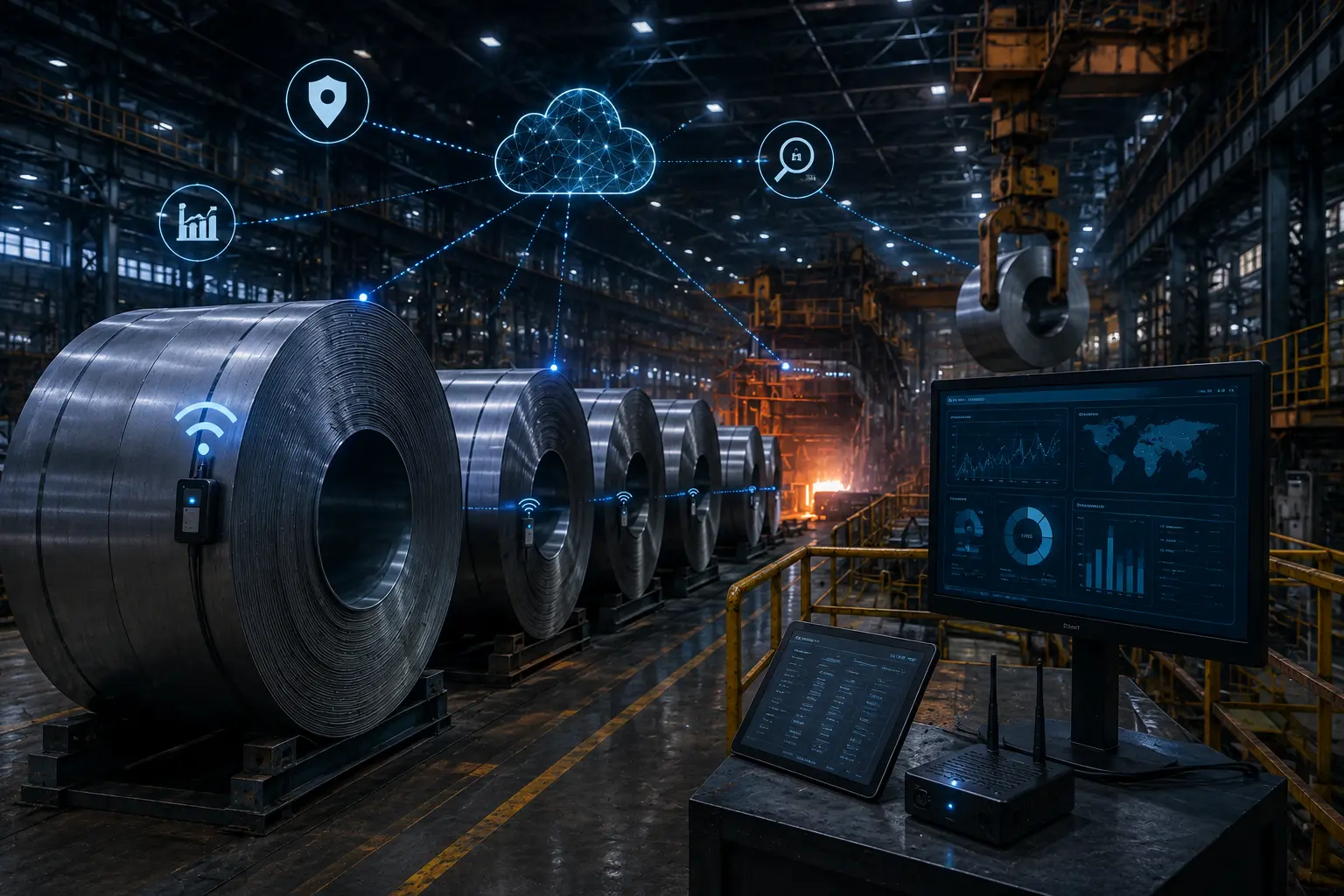
IoT Software for Coil Handling and Rolling Mill Operations
The Software Layer Behind Every Coil Tag and Mill Badge
Device Management and Data Capture Software for Identification and Location Hardware on the Rolling Floor
Metal forming and rolling operations depend on the continuous movement of coils, slabs, work rolls, mobile equipment, and production personnel. RFID coil tags, BLE worker badges, GPS asset beacons, access credentials, and industrial readers generate valuable operational information, but these identification technologies require specialized IoT software to manage devices, collect data, maintain communication, and exchange information with enterprise manufacturing systems.
MetalProcess AI provides IoT software specifically designed for rolling mills, coil yards, and forming operations where reliable identification and location information supports production efficiency, inventory accuracy, worker safety, and product traceability. The software acts as the operational layer between physical identification hardware and higher-level AI applications, ensuring that data collected from RFID readers, BLE gateways, GPS tracking devices, and industrial edge computers is accurate, synchronized, and immediately available for operational use.
Artificial Intelligence of Things, commonly called AIoT or AI and IoT, combines artificial intelligence with IoT devices, sensors, connected equipment, and industrial systems. AIoT solutions may also use Industrial AI, Edge AI, machine learning, computer vision, and, in autonomous applications, Physical AI. Within rolling operations, IoT software forms the foundation of this environment by managing connected identification technologies, organizing operational data, and delivering trusted information to AI software and enterprise business systems.
Unlike AI software, which analyzes operational data and supports decision-making, IoT software focuses on securely connecting identification devices, validating captured information, maintaining communication between hardware and enterprise applications, and ensuring reliable data collection across demanding industrial environments.
These capabilities create a dependable digital foundation for personnel tracking, access control, coil identification, inventory management, work-in-progress visibility, and material genealogy throughout rolling operations.
Overview of IoT Software for Rolling Operations
Modern rolling mills generate thousands of identification events every hour. Workers authenticate access credentials when entering production areas. Overhead cranes move RFID-tagged coils between storage locations. Forklifts transport work rolls across maintenance facilities. Finished coils are transferred to warehouses before shipment. Mobile yard equipment continuously changes location while supporting production logistics.
Without specialized IoT software, managing these identification technologies would require multiple disconnected applications, increasing administrative effort and reducing operational visibility.
MetalProcess AI centralizes these activities by providing software that performs several essential functions:
Because the software emphasizes identification and location technologies rather than traditional industrial monitoring, it aligns closely with the operational priorities of metal forming and rolling facilities.
Reliable IoT software also improves deployment scalability. As organizations expand production capacity, add new coil yards, install additional production lines, or modernize existing facilities, identification devices can be incorporated into the existing software environment without fundamentally changing enterprise business systems.
Common communication technologies supported by the software include:
This broad communication support allows rolling operations to connect identification technologies with Manufacturing Execution Systems (MES), Enterprise Resource Planning (ERP), Warehouse Management Systems (WMS), Computerized Maintenance Management Systems (CMMS), Quality Management Systems (QMS), and production reporting software.
AI-Powered Personnel Identification and Access Analytics Workflow for Rolling Mill Safety
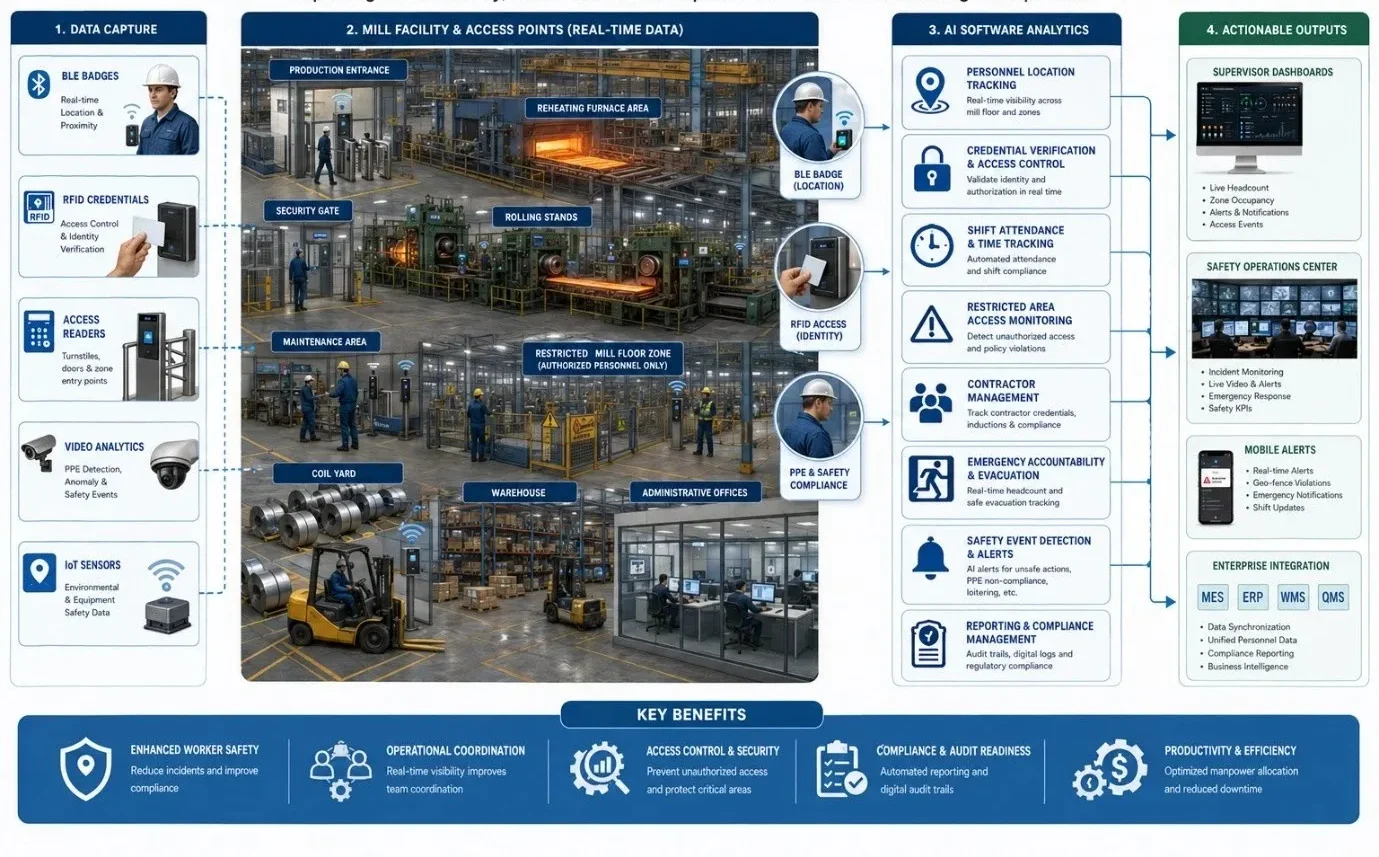
This operational workflow diagram shows how AI and IoT technologies enhance personnel identification, access control, and worker safety across a rolling mill. It shows BLE badges, RFID credentials, access readers, and AI analytics monitoring personnel movement, restricted-area access, shift attendance, contractor activities, emergency accountability, and safety compliance while delivering actionable insights to supervisors and enterprise dashboards.
Brief Description of Applications in Metal Forming & Rolling
IoT software supports identification and location workflows across numerous rolling and forming operations where reliable device communication and data capture are essential. Typical applications include:
Within these environments, IoT software provides consistent management of RFID tags, BLE badges, GPS asset beacons, and industrial communication infrastructure, ensuring that identification and location data remains accurate, synchronized, and available for AI software and enterprise manufacturing systems.
RFID Badge and Access Credential Software
Rolling mills operate with strict safety procedures and controlled access requirements. Personnel routinely move between production entrances, rolling stands, reheating furnace areas, maintenance workshops, crane systems, coil yards, quality laboratories, warehouses, and administrative facilities. Managing digital identities across these operational areas requires IoT software that securely administers credentials, records identification events, and exchanges access information with enterprise systems.
MetalProcess AI provides RFID badge and access credential software designed specifically for industrial manufacturing environments. Rather than making operational decisions, the software focuses on managing worker identities, maintaining credential validity, collecting access events, and delivering accurate identification information to AI software and business applications.
The software supports production personnel, contractors, visitors, maintenance teams, quality engineers, warehouse operators, and authorized external service providers while maintaining a consistent digital identity throughout the facility.
Digital Identity Management
Each worker or authorized visitor receives a unique digital identity associated with an RFID badge, BLE badge, or secure access credential. IoT software maintains this identity throughout its lifecycle, ensuring accurate association between personnel and operational activities. Typical functions include:
This centralized identity management helps reduce administrative effort while improving consistency across multiple production areas.
RFID Badge Administration
Large rolling facilities may issue thousands of RFID badges to employees working across different departments and shifts. IoT software simplifies administration by maintaining a complete inventory of active credentials and their operational status. Capabilities include:
Because the software maintains complete credential histories, organizations can simplify compliance reporting and internal audits.
Access Control Management Software
Access control readers installed throughout rolling facilities generate continuous identification events. IoT software collects these events, validates credential information, and securely exchanges access records with enterprise applications. Supported functions include:
These capabilities establish a reliable operational record while supporting worker accountability and facility security.
Communication with Enterprise Systems
Access credential software is most effective when integrated with manufacturing and business applications. MetalProcess AI supports communication with existing enterprise systems without requiring organizations to redesign established workflows. Typical integration targets include:
Supported communication standards include MQTT, OPC UA, REST APIs, HTTPS, LDAP, and secure database synchronization.
Coil and Roll Asset Tag Management Software
Efficient material handling depends on reliable identification of production assets throughout the manufacturing process. Steel coils, aluminum coils, work rolls, backup rolls, lifting fixtures, transport equipment, and reusable production assets require persistent digital identities that remain associated with each item during storage, movement, processing, maintenance, and shipment.
MetalProcess AI provides IoT software that manages RFID coil tags, asset identifiers, and associated operational records. The software maintains device registration, tag assignment, communication status, and historical identification events while supporting integration with manufacturing and inventory systems.
Unlike AI software, which analyzes production performance, IoT software focuses on maintaining the quality, consistency, and availability of identification data.
RFID Coil Tag Management
Each production coil receives a unique digital identity that remains associated with the material throughout its manufacturing lifecycle. IoT software manages these identities from initial registration through shipment. Typical functions include:
Maintaining consistent digital identities reduces the possibility of duplicate records while improving inventory accuracy.
Work Roll Asset Management
Rolling operations depend on numerous reusable production assets that require accurate identification throughout maintenance and production. IoT software supports:
Reliable asset identification helps maintenance teams locate critical production assets quickly while maintaining complete operational records.
Mobile Asset Registration
Forklifts, overhead cranes, transfer cars, coil carriers, and yard vehicles are essential for material movement throughout rolling operations. IoT software maintains digital records for these mobile assets, enabling consistent identification across production and logistics activities. Typical capabilities include:
These records support enterprise applications that depend on accurate asset identification without performing operational analytics.
Benefits of Centralized Asset Tag Management
A centralized software solution for managing identification devices provides operational consistency throughout the facility. Organizations benefit from:
By maintaining trusted identification records across coils, production assets, and mobile equipment, IoT software establishes the reliable data foundation required for inventory management, work-in-progress tracking, traceability, and higher-level AI applications.
Inventory Visibility Software for Coil Yards
Coil yards serve as critical operational hubs where raw materials, intermediate coils, and finished products are stored, staged, and prepared for subsequent production or shipment. Maintaining an accurate, continuously updated inventory across these areas is challenging because coils are frequently moved by overhead cranes, forklifts, transfer cars, and yard handling equipment. Manual inventory reconciliation often becomes time consuming, particularly in large facilities processing thousands of coils every day.
MetalProcess AI provides IoT software that continuously captures identification and location events from RFID coil tags, BLE devices, GPS asset beacons, industrial readers, and edge computing systems. Rather than performing AI-based operational analysis, the software focuses on maintaining accurate digital inventory records and delivering trusted identification data to enterprise business systems.
Reliable inventory visibility enables production planners, warehouse personnel, logistics coordinators, and operations managers to locate coils quickly while reducing unnecessary searches and duplicate inventory records.
Digital Coil Inventory Management
Every coil can be associated with a persistent digital record that remains synchronized throughout receiving, storage, production staging, intermediate processing, and shipment. The IoT software manages information such as:
Maintaining these records within a centralized software solution improves inventory consistency across multiple production departments.
Real-Time Location Updates
Material movement occurs continuously throughout rolling operations. Coils are relocated between receiving areas, storage racks, rolling lines, inspection stations, finishing operations, slitters, packaging areas, and outbound staging locations. IoT software records identification events generated by industrial readers and updates asset locations whenever authorized movement occurs. Typical location management functions include:
These capabilities provide personnel with a current operational view of inventory without relying on manual record updates.
Inventory Synchronization with Enterprise Systems
Inventory data becomes significantly more valuable when synchronized with enterprise software used throughout manufacturing and logistics operations. MetalProcess AI supports integration with:
Using industrial communication standards such as MQTT, OPC UA, REST APIs, HTTPS, and secure database synchronization, inventory information remains consistent across operational and business applications.
Operational Benefits
Accurate inventory visibility contributes to smoother production and warehouse operations by reducing uncertainty regarding coil locations and material availability. Organizations commonly experience improvements such as:
Work-in-Progress Tracking Software
Rolling operations involve continuous material transformation through multiple production stages. A single coil may move through reheating, hot rolling, cooling, pickling, cold rolling, annealing, temper rolling, slitting, inspection, packaging, and shipping before becoming a finished product.
Each production movement creates identification events that must be captured, organized, and synchronized across manufacturing systems.
MetalProcess AI provides Work-in-Progress (WIP) tracking software that records these identification events and maintains accurate production histories without performing production optimization or predictive analysis. The software establishes the trusted operational data required by AI software and enterprise manufacturing applications.
Digital Production Tracking
Every production stage generates important identification records associated with specific coils, work orders, and production batches. Typical WIP records include:
Maintaining these records throughout production improves operational transparency while reducing manual documentation.
Support for Multiple Rolling Processes
Rolling facilities often operate several production lines with different processing characteristics. The software supports identification workflows across:
Because each facility follows unique production workflows, configurable software allows organizations to adapt identification processes without replacing existing manufacturing systems.
Production Movement Recording
Material movement between production areas represents an important part of work-in-progress management. IoT software records events generated during:
These identification records provide a chronological production history that supports manufacturing documentation and enterprise reporting.
IoT Software Workflow for Work-in-Progress Tracking Across Rolling Mill Production
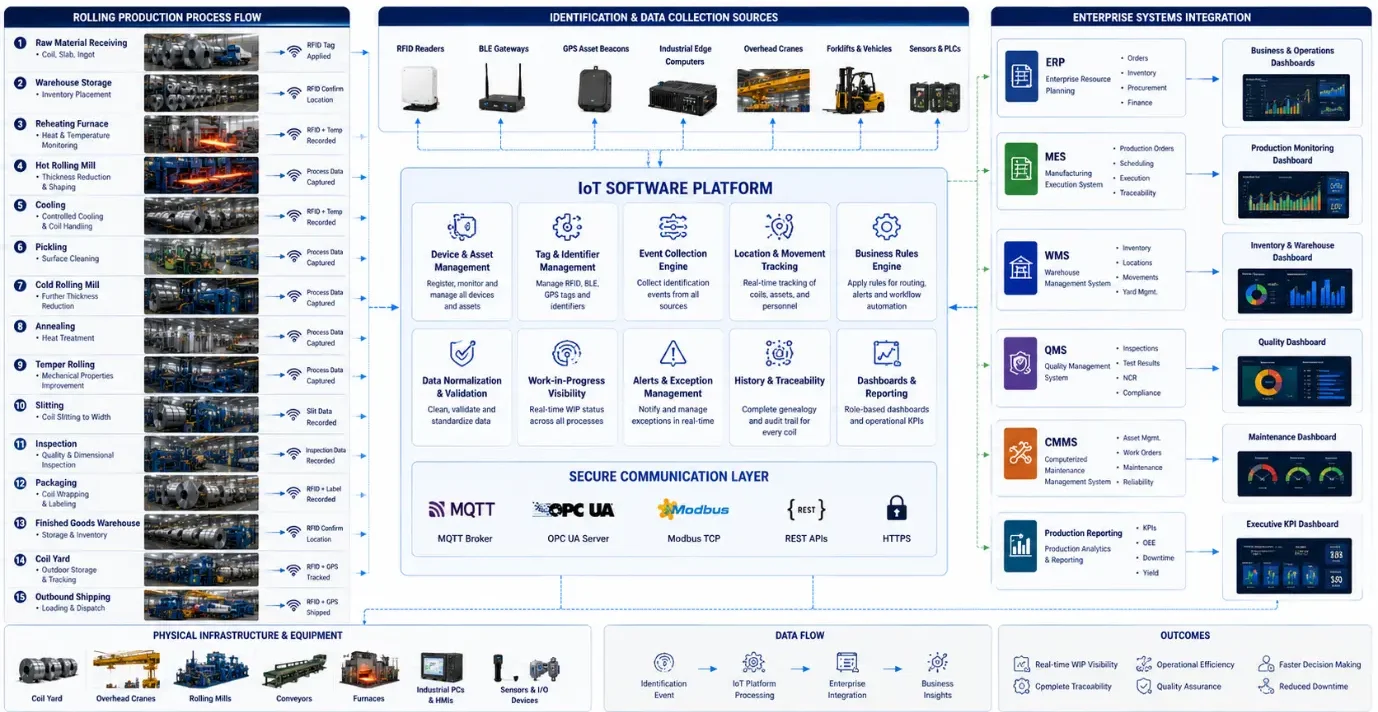
This enterprise workflow diagram shows how IoT software manages work-in-progress tracking throughout the complete rolling production lifecycle. It shows identification and movement data collected from RFID readers, BLE gateways, GPS asset beacons, industrial edge computers, cranes, and forklifts, then securely integrated with ERP, MES, WMS, QMS, CMMS, and production reporting systems to enable real-time traceability, inventory visibility, production control, quality management, and executive decision support.
Coil and Batch Genealogy Capture Software
Maintaining complete production genealogy is essential for metal forming and rolling operations that supply automotive manufacturers, aerospace suppliers, construction material producers, appliance manufacturers, energy equipment fabricators, and other industries requiring documented material histories. Every finished coil should be traceable back to its originating heat, production batch, processing sequence, and finished shipment.
MetalProcess AI provides IoT software that captures and maintains this genealogy by collecting identification events from RFID coil tags, industrial readers, BLE identification devices, and connected production systems. The software creates reliable digital records that support quality documentation, customer reporting, regulatory compliance, and internal manufacturing processes.
Rather than interpreting genealogy information or making production recommendations, the IoT software focuses on capturing, organizing, validating, and securely storing identification records that higher-level AI software and enterprise applications can use.
Digital Coil Genealogy
Each production coil can be associated with a comprehensive digital history covering every significant movement and production stage. Typical genealogy records include:
These records provide manufacturers with a consistent digital chain of identification throughout the production lifecycle.
Batch History Management
Many manufacturers process multiple heats, alloy grades, dimensions, and customer orders simultaneously. IoT software helps maintain relationships between production batches without requiring manual reconciliation. Supported functions include:
Reliable batch documentation simplifies quality investigations and supports customer-specific reporting requirements.
Enterprise Traceability Support
Identification records become significantly more valuable when synchronized with enterprise software responsible for manufacturing documentation and quality management. MetalProcess AI supports integration with:
These integrations help maintain consistent genealogy information throughout the organization while minimizing duplicate data entry.
Understanding the Difference Between IoT Software and AI Software
Although AIoT solutions combine AI and IoT technologies, each software layer performs a distinct operational role.
IoT software is responsible for communicating with RFID readers, BLE gateways, GPS asset beacons, access control devices, and edge computing systems. It registers devices, validates identification events, synchronizes operational records, and exchanges information with enterprise applications.
AI software operates after trusted identification data has been collected. Using the information supplied by the IoT software layer, AI applications can identify production trends, recognize operational patterns, support production planning, improve asset utilization, forecast inventory requirements, assist with workforce safety initiatives, and help detect process bottlenecks.
Separating these responsibilities improves system reliability, simplifies maintenance, and allows organizations to modernize AI capabilities without replacing their existing identification infrastructure.
Primary Responsibilities of IoT Software
IoT software commonly manages:
Primary Responsibilities of AI Software
AI software typically focuses on:
Together, these software layers create a complete AIoT solution while maintaining clear functional separation between data collection and operational decision support.
Applications Across Metal Forming and Rolling
MetalProcess AI IoT software supports identification and location workflows across a broad range of rolling and metal processing operations, including:
Across these environments, the software manages RFID coil tags, BLE personnel badges, GPS asset beacons, access credentials, and identification records that support inventory visibility, production documentation, and enterprise integration.
Experience Built on Industrial IoT Deployments
MetalProcess AI was created within Aperture Venture Studio with support from GAO, drawing upon more than two decades of industrial IoT experience across manufacturing and industrial operations. The solution reflects practical knowledge gained through thousands of customer engagements and successful IoT deployments.
Extensive investment in research and development, rigorous quality assurance processes, and remote as well as onsite technical support contribute to software designed for demanding production environments. Development is guided by Ph.D. professionals from leading universities and strengthened through collaboration with industry experts and strategic partners. Over the years, the underlying experience has supported Fortune 500 manufacturers, research organizations, universities, and government agencies in the United States and Canada.
This operational background influences the software’s focus on dependable identification, reliable communication, enterprise interoperability, and long-term maintainability for complex rolling facilities.
Contact Us