
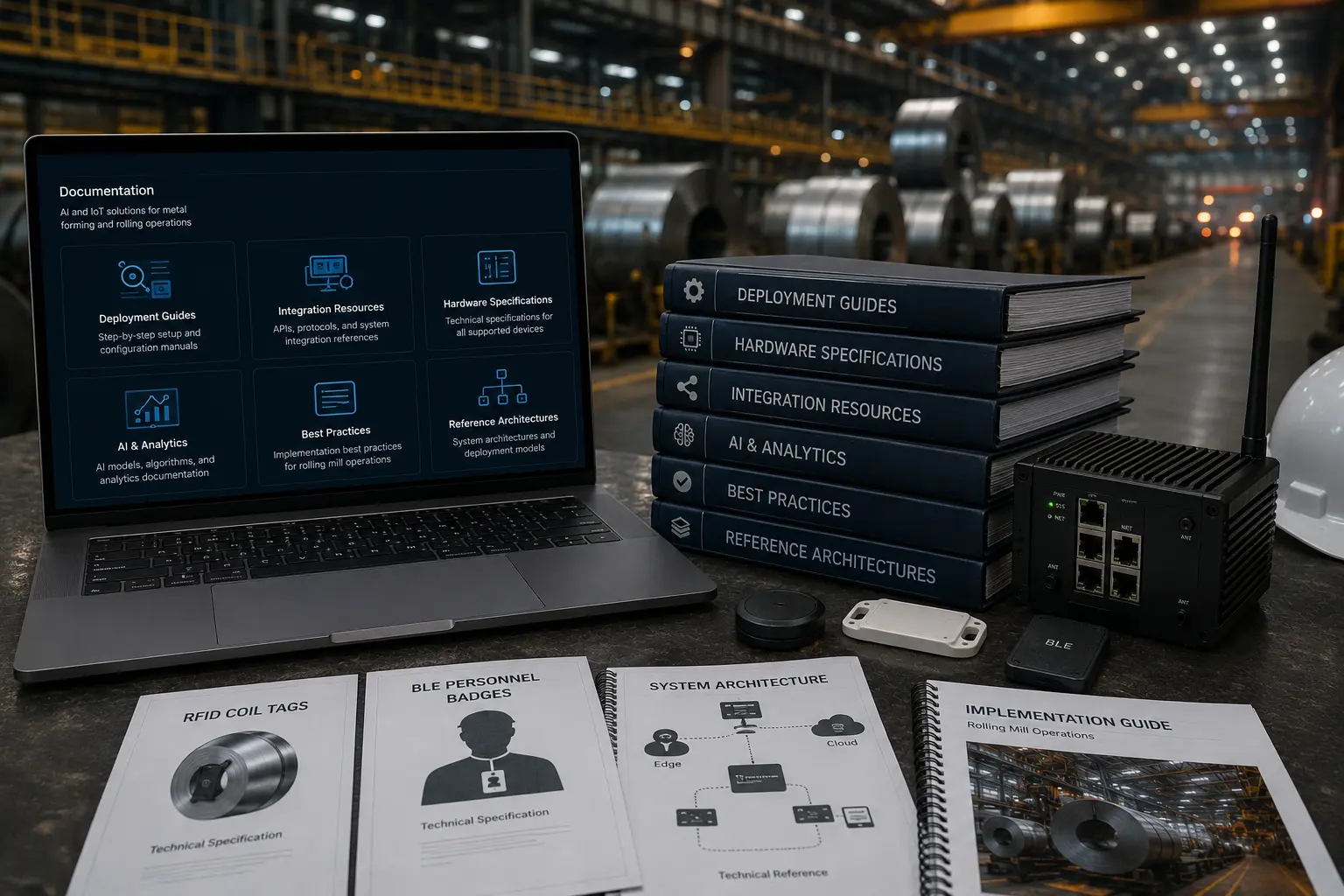
Resources for AIoT Deployment in Metal Forming & Rolling
Technical Reference for Rolling Mill Deployments
Documentation, implementation guidance, and technical specifications supporting AI and IoT identification and location solutions throughout rolling mill operations, coil yards, forming lines, and finishing facilities.
Metal forming and rolling operations rely on synchronized production, precise material identification, workforce safety, controlled access, and continuous asset visibility. Hot rolling mills, cold rolling facilities, tandem mills, reversing mills, skin pass mills, slitting lines, pickling lines, temper mills, coil storage yards, and shipping operations all require accurate identification and location information that integrates with existing manufacturing software.
This resource center provides technical documentation for organizations implementing AI and IoT solutions throughout rolling operations. Rather than focusing only on individual devices, these resources explain how identification technologies, AI software, industrial communications, and enterprise business systems work together to improve operational efficiency.
Artificial Intelligence of Things, commonly called AIoT or AI and IoT, combines artificial intelligence with IoT devices, connected equipment, and industrial systems. AIoT solutions may also use Industrial AI, Edge AI, machine learning, computer vision, and Physical AI where appropriate. Within rolling operations, these technologies support personnel location, controlled access, coil identification, inventory visibility, work-in-progress tracking, and complete material genealogy.
The documentation throughout this resource center emphasizes identification and location technologies including RFID, BLE, LoRaWAN, GPS, industrial edge computing, and enterprise software integration for rolling mills.
MetalProcess AI was created within Aperture Venture Studio with support from GAO. The knowledge presented throughout these resources reflects practical deployment experience accumulated through thousands of industrial IoT projects over two decades, helping organizations implement identification solutions across demanding industrial manufacturing environments.
AI and IoT Documentation Framework for Metal Forming and Rolling Operations
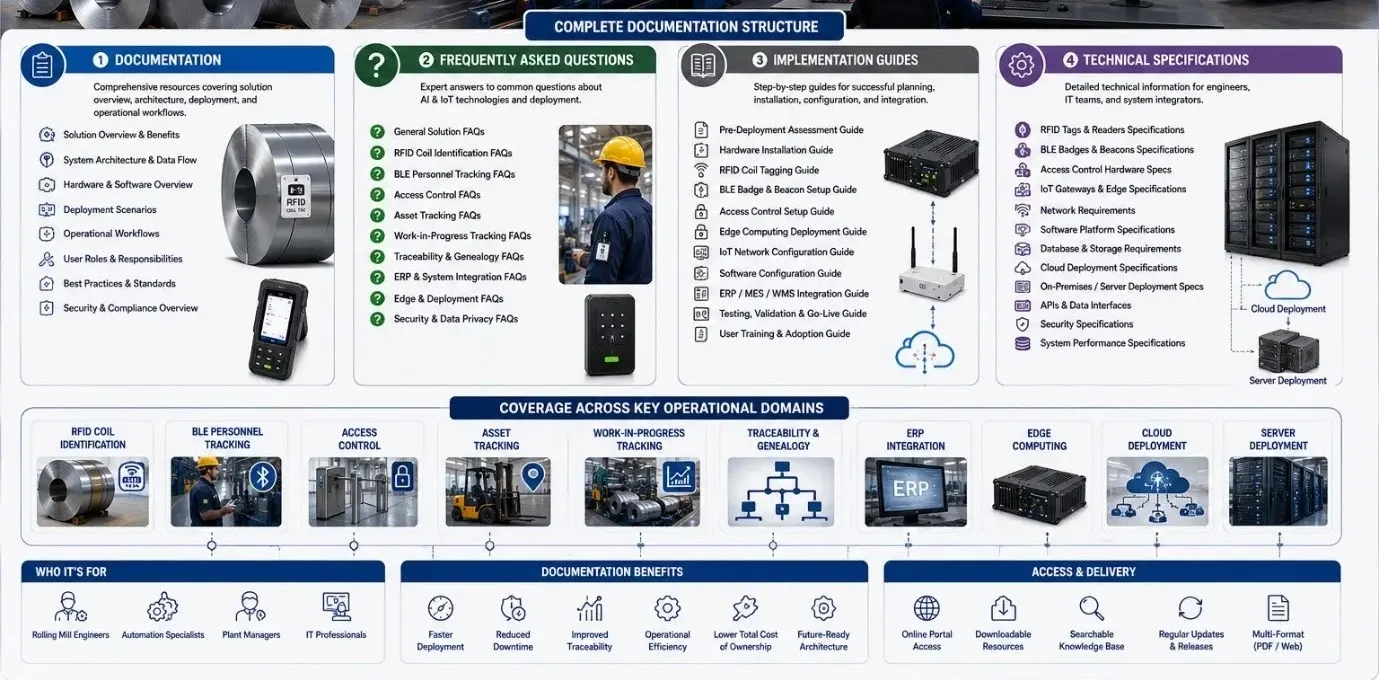
This enterprise documentation overview infographic presents the complete knowledge framework supporting AI and IoT deployment in metal forming and rolling operations. It organizes documentation, frequently asked questions, implementation guides, and technical specifications while linking key topics such as RFID coil identification, BLE personnel tracking, access control, asset tracking, work-in-progress tracking, traceability, ERP integration, edge computing, cloud deployment, and server infrastructure for engineers, automation specialists, plant managers, and IT professionals.
Documentation
Successful AI and IoT deployments in rolling operations depend upon comprehensive engineering documentation rather than isolated product manuals. Identification systems influence multiple departments including production, maintenance, quality assurance, warehouse management, logistics, information technology, cybersecurity, and executive reporting.
The documentation produced by MetalProcess AI is organized according to actual deployment activities performed throughout rolling mill modernization projects.
System Design Documentation
System design documents establish how AI and IoT identification technologies integrate into daily rolling operations. Typical documentation includes:
These engineering documents help project teams understand how identification data flows across receiving, reheating, hot rolling, cold rolling, annealing, temper rolling, slitting, inspection, warehousing, and shipping.
Identification Standards Documentation
Consistent identification throughout rolling operations requires standardized naming conventions, labeling procedures, and digital identities. Documentation commonly defines:
Standardized documentation prevents duplicate identifiers while improving material traceability throughout production.
RFID Documentation
RFID documentation explains how identification technologies support coil movement throughout the production lifecycle. Typical engineering documentation includes:
Rolling facilities often require different RFID deployment methods depending upon coil diameter, storage density, overhead crane operations, and conveyor layouts.
BLE Documentation
BLE documentation supports workforce safety, authorized access, mobile assets, and production equipment requiring continuous location awareness. Documentation typically includes:
BLE deployments improve visibility without interrupting daily production activities.
Enterprise Integration Documentation
Industrial software rarely operates independently inside modern rolling facilities. Integration documentation explains how AI-generated identification data exchanges information with existing business systems including:
Documentation includes communication interfaces, synchronization schedules, data ownership, validation procedures, and recovery methods for system interruptions.
Documentation Available by Operational Area
Documentation is organized according to actual production workflows within rolling facilities, allowing engineering teams to locate relevant deployment guidance quickly.
Personnel Identification Documentation
Resources include:
Asset Identification Documentation
Engineering documentation supports:
Inventory Documentation
Inventory documentation focuses on:
These resources reduce manual inventory activities while improving production planning and shipping accuracy.
Work-in-Progress Documentation
Production documentation explains how identification information supports continuous visibility throughout manufacturing. Coverage includes:
These procedures provide production managers with consistent visibility into material flow across multiple processing stages.
Frequently Asked Questions (FAQs)
How does AI and IoT improve rolling mill operations?
AI and IoT combines artificial intelligence with connected industrial devices and identification technologies to improve operational visibility throughout rolling operations. Rather than relying on manual updates, AI software processes identification events from RFID, BLE, GPS, LoRaWAN, and edge computing systems to support personnel location, access control, coil tracking, inventory visibility, work-in-progress management, and traceability.
For rolling facilities, the greatest value comes from knowing the identity, location, movement history, and operational status of workers, coils, equipment, and production assets without disrupting existing manufacturing workflows.
Why is RFID widely used for coil identification?
Steel coils, aluminum coils, stainless steel products, and other rolled materials move repeatedly between storage yards, processing lines, inspection stations, slitting operations, warehouses, and shipping areas. RFID enables:
Industrial RFID tags can remain associated with material throughout multiple production stages, allowing AI software to build accurate production histories.
Where is BLE most effective within rolling facilities?
BLE is commonly deployed for personnel identification and mobile asset location. Typical applications include:
BLE complements RFID by supporting moving personnel rather than stationary production materials.
Can existing ERP software remain in operation?
Yes. Most rolling facilities continue operating their existing ERP software while adding AI and IoT identification capabilities. Integration commonly supports:
Existing business processes generally remain unchanged while receiving improved identification data.
Is cloud deployment required?
No. Organizations commonly choose deployment models based on:
Many rolling facilities continue operating server-based software inside plant networks, while others deploy hybrid or cloud software depending on operational objectives.
How does AI support work-in-progress visibility?
AI software correlates identification events collected throughout production to understand material movement across rolling operations. Examples include:
Production managers obtain near real-time visibility without requiring operators to manually update production status continuously.
Implementation Guides
Rolling mill modernization requires structured planning rather than isolated hardware installation. MetalProcess AI provides implementation guidance that aligns engineering practices, identification technologies, enterprise software integration, and operational objectives while minimizing production disruption.
Drawing upon practical experience from thousands of industrial IoT deployments through GAO over two decades, these guides reflect established engineering methodologies applicable to demanding manufacturing environments.
Operational Assessment Guide
Every deployment begins with a comprehensive assessment of production operations. Topics include:
Assessment documentation establishes deployment priorities before implementation begins.
Identification Planning Guide
Identification planning defines how every important operational object receives a unique digital identity. Coverage includes:
Consistent identification supports reliable AI analysis throughout production.
RFID Deployment Guide
Engineering guidance explains practical RFID implementation throughout rolling operations. Topics include:
The objective is reliable identification despite challenging industrial environments involving heat, vibration, dust, metal interference, and continuous material movement.
BLE Deployment Guide
BLE implementation guidance supports workforce visibility and mobile asset management. Documentation covers:
Deployment recommendations balance location accuracy with infrastructure simplicity.
Enterprise Software Integration Guide
Rolling operations typically depend upon multiple industrial software systems. Integration guidance explains connections with:
Guidance emphasizes controlled information exchange while maintaining data consistency across departments.
Technical Specifications
Successful AI and IoT deployments depend upon clearly documented technical specifications that define system capabilities, interoperability, performance expectations, and deployment constraints.
MetalProcess AI maintains technical references covering identification technologies commonly deployed throughout rolling operations.
RFID Technical Specifications
Engineering specifications typically include:
These specifications assist engineering teams in selecting RFID components appropriate for coil yards, rolling lines, warehouses, and shipping operations.
BLE Technical Specifications
BLE documentation generally covers:
BLE specifications support workforce safety, controlled access, and mobile asset identification while minimizing maintenance requirements.
Technical Specifications for Industrial Connectivity
AI and IoT deployments in rolling operations require careful selection of communication technologies based on facility layout, operating conditions, data requirements, and integration objectives. Technical specifications help engineering teams determine the appropriate combination of RFID, BLE, LoRaWAN, GPS, cellular connectivity, and edge computing solutions.
Industrial Communication Specifications
Technical documentation may include:
Rolling mills frequently combine multiple connectivity technologies because production environments contain different operational zones including furnace areas, rolling stands, coil storage yards, finishing areas, warehouses, and shipping zones.
Edge Computing Specifications
Edge computing documentation supports deployments requiring local data processing close to production operations. Technical references include:
Edge computing allows AI and IoT solutions to continue supporting operations even when connectivity to external systems is limited.
Cloud and Server Deployment Specifications
Organizations select deployment models according to operational requirements and IT policies.
Cloud software deployment documentation covers:
Server software deployment documentation covers:
Both deployment methods can support AI-enabled identification and location solutions for rolling operations.
AI and IoT Deployment Best Practices for Rolling Operations
Successful deployment requires alignment between production engineering, automation teams, IT departments, and operational users. Recommended practices include:
A structured implementation approach reduces operational disruption and improves long-term system reliability.
Resources Supporting Specific Rolling Mill Applications
MetalProcess AI resources are designed for multiple rolling operation scenarios, including hot rolling, cold rolling, coil yards, forming lines, finishing operations, and shipping areas.
Hot Rolling Mill Resources
Hot rolling operations require reliable identification of slabs, billets, and coils moving through high-temperature production areas.
- Material identification planning
- Coil tracking documentation
- Production flow guides
- RFID deployment references
- Work-in-progress tracking procedures
- Integration documentation
Cold Rolling Mill Resources
Cold rolling facilities require accurate tracking across multiple processing stages.
- Coil routing
- Material genealogy
- Process status updates
- Inventory verification
- Quality workflow integration
- Finished product tracking
Coil Yard Resources
Coil yards often contain thousands of stored coils requiring accurate location information.
- Yard mapping procedures
- RFID identification methods
- GPS asset tracking references
- Inventory reconciliation processes
- Crane operation documentation
- Storage location management
Forming and Finishing Line Resources
Forming presses, slitting lines, and finishing operations require coordinated material movement.
- Work-in-progress identification
- Production sequence tracking
- Tool and equipment identification
- Finished product management
- Quality traceability
- Shipping verification
Hot Rolling Mill Resources: AI and IoT solutions support improved visibility from reheating furnaces through roughing mills, finishing mills, cooling areas, and coil handling operations.
Cold Rolling Mill Resources: AI and IoT identification solutions help connect production information from cold rolling, annealing, coating, inspection, and packaging processes.
Coil Yard Resources: AI software can analyze identification events to improve coil retrieval, inventory accuracy, and shipment preparation.
Forming and Finishing Line Resources: These resources help manufacturing teams connect production information across multiple processing stages.
AI and IoT Deployment Decision Tree for Rolling Mill Operations
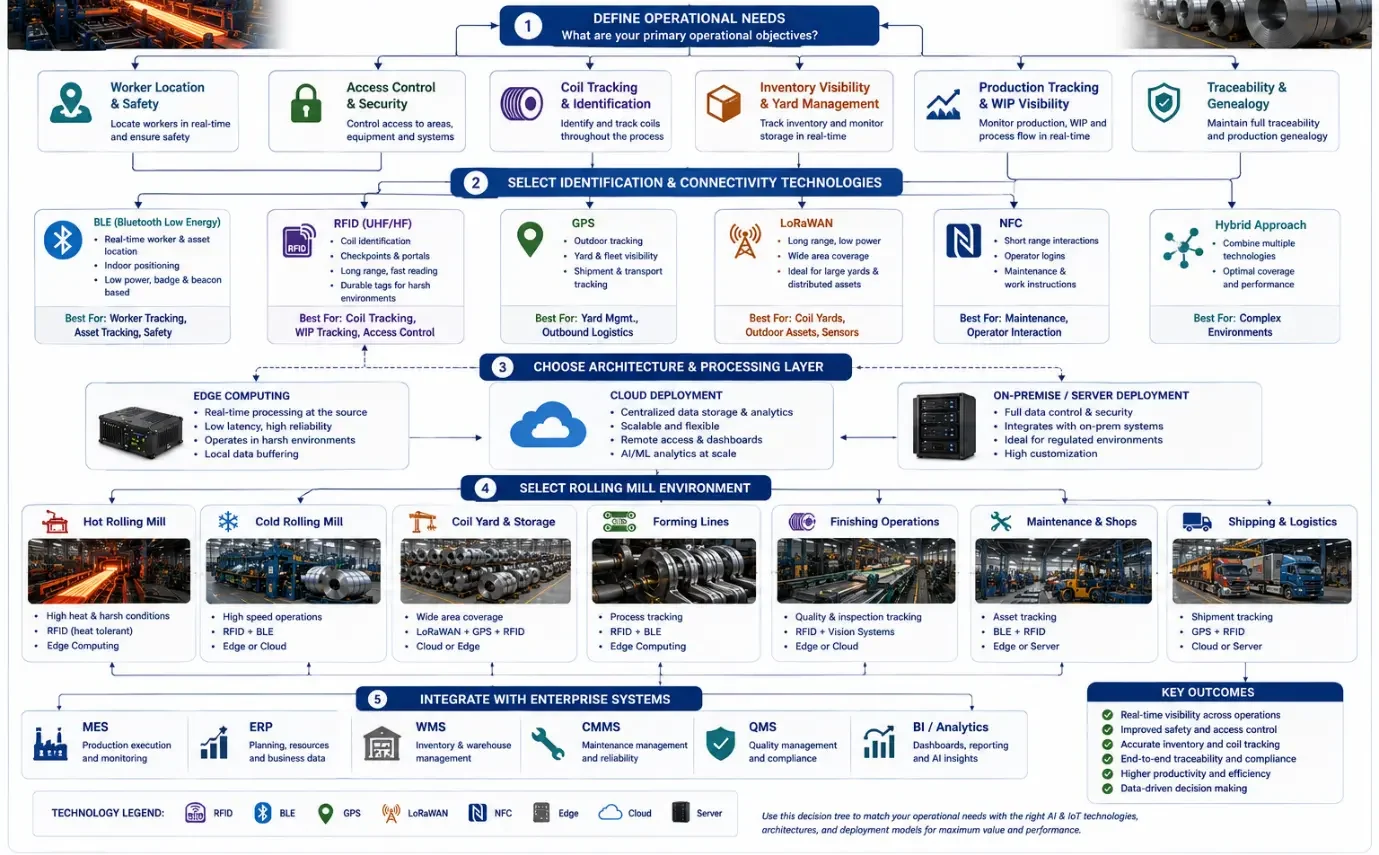
This enterprise decision tree guides engineering teams in selecting appropriate AI and IoT deployment resources based on operational requirements such as worker location, access control, coil tracking, inventory visibility, production monitoring, and traceability. It maps these requirements to technologies including RFID, BLE, GPS, LoRaWAN, edge computing, cloud deployment, and on-premises server solutions while considering hot rolling, cold rolling, coil yards, forming lines, and finishing operations to support informed deployment planning.
About MetalProcess AI Resources
MetalProcess AI develops AI and IoT solutions for industrial manufacturing operations based on practical experience from GAO and its technology organizations.
Created within Aperture Venture Studio with support from GAO, MetalProcess AI builds upon two decades of IoT experience and thousands of completed IoT projects. The company applies this experience to help organizations deploy identification, location, access control, asset tracking, inventory, and production visibility solutions.
The technical resources provided by MetalProcess AI are supported by research and development investments, quality assurance processes, and expert support delivered remotely or onsite. Engineering teams led by Ph.D. professionals from leading universities contribute technical knowledge across industrial IoT, RFID, BLE, edge computing, and enterprise software integration.
Over the years, GAO organizations have supported Fortune 500 companies, research and development organizations, universities, and U.S. and Canadian government agencies with IoT-based products and solutions.
Building Reliable AI and IoT Deployments for Rolling Operations
AI and IoT deployment in metal forming and rolling requires more than installing connected devices. Reliable results depend on accurate identification methods, industrial connectivity, software integration, cybersecurity planning, and operational understanding.
Technical documentation, implementation guides, FAQs, and specifications provide engineering teams with the resources needed to plan, deploy, and maintain AI-enabled identification solutions throughout rolling operations.
From coil identification and worker location to inventory visibility and production tracking, MetalProcess AI resources support organizations building connected rolling operations with practical engineering guidance and proven IoT deployment methodologies.