
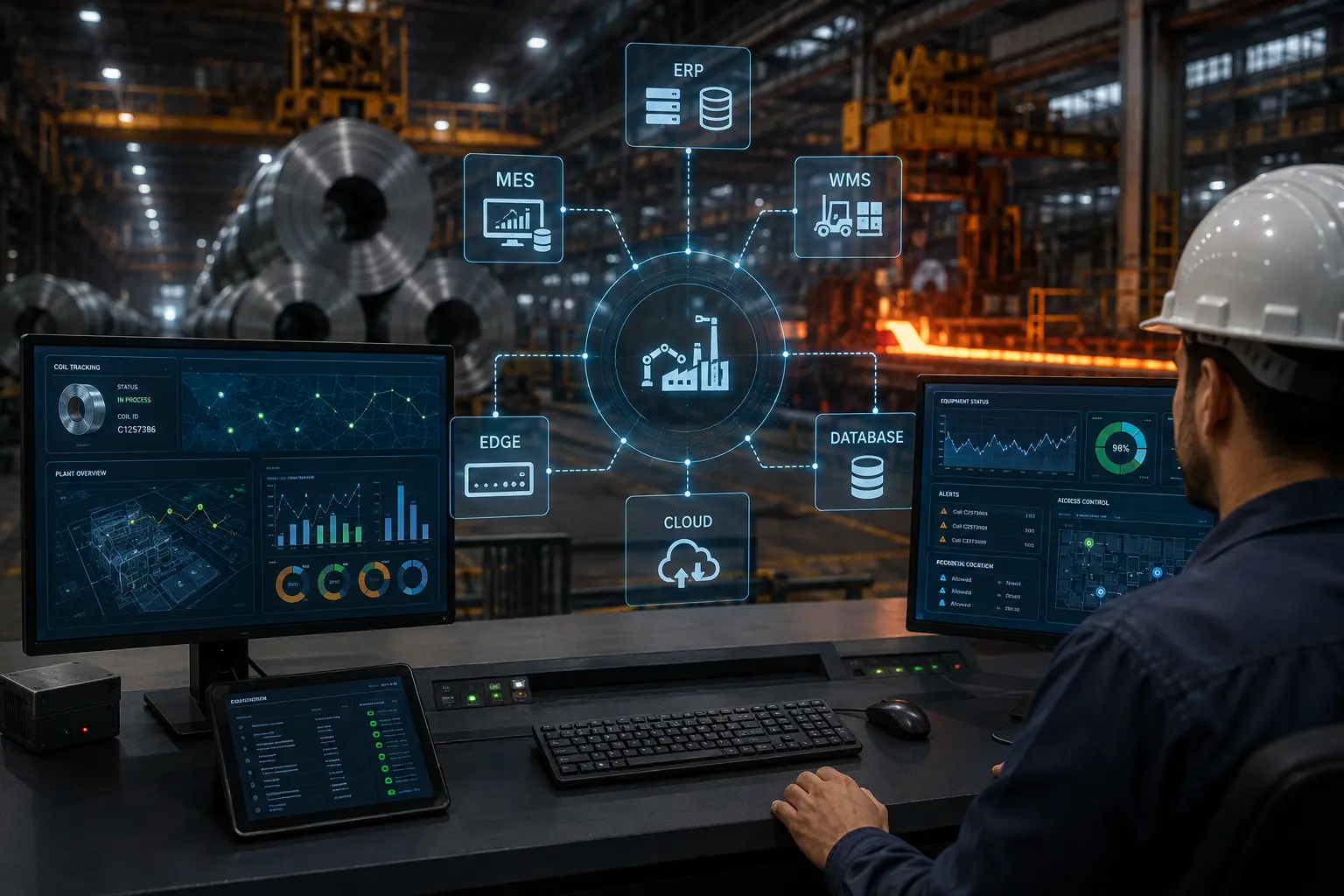
Integration for AIoT-Enabled Rolling Mill Operations
Where Coil Data, Access Data, and Production Data Meet
System connectivity and deployment models that bring AI and IoT identification and location data into existing rolling mill operations while supporting coil tracking, personnel identification, inventory visibility, production flow, and material traceability.
AI and IoT Integration for Metal Forming and Rolling
Modern metal forming and rolling operations rely on continuous material movement across receiving, reheating, hot rolling, cold rolling, pickling, annealing, temper rolling, slitting, finishing, warehousing, and outbound shipping. Every steel coil, aluminum coil, work roll, backup roll, transfer cart, overhead crane, forklift, production operator, contractor, and maintenance technician continuously generates identification and location events that must be shared across operational software.
AIoT combines artificial intelligence with IoT devices, connected equipment, and industrial systems. AI and IoT solutions may also use Industrial AI, Edge AI, machine learning, computer vision, and Physical AI to improve operational decision making. Within rolling operations, however, the primary value comes from reliable identification and location data rather than continuous sensing. RFID, BLE, GPS, and LoRaWAN technologies establish trusted digital identities for people and physical assets, while AI software analyzes movement patterns, utilization, production flow, and operational exceptions.
Effective integration allows every identification event generated throughout the rolling mill to become immediately available to operational software responsible for production scheduling, inventory management, maintenance planning, quality documentation, shipping coordination, and enterprise reporting. Rather than creating isolated software environments, integration connects existing mill systems so operational teams can make decisions using consistent, synchronized information.
MetalProcess AI focuses on connecting identification technologies with enterprise software commonly deployed throughout steel mills, aluminum rolling facilities, stainless steel processing plants, specialty alloy manufacturers, and service centers handling slit coils, sheet products, strip steel, and finished rolled products.
Applications Across Metal Forming and Rolling
Integrated AI and IoT identification solutions support numerous production environments throughout rolling facilities. Applications include:
Each operation depends on reliable identification of personnel, equipment, material, and production assets to maintain operational continuity while reducing manual record keeping.
Enterprise AI and IoT Integration System for Metal Forming and Rolling Operations
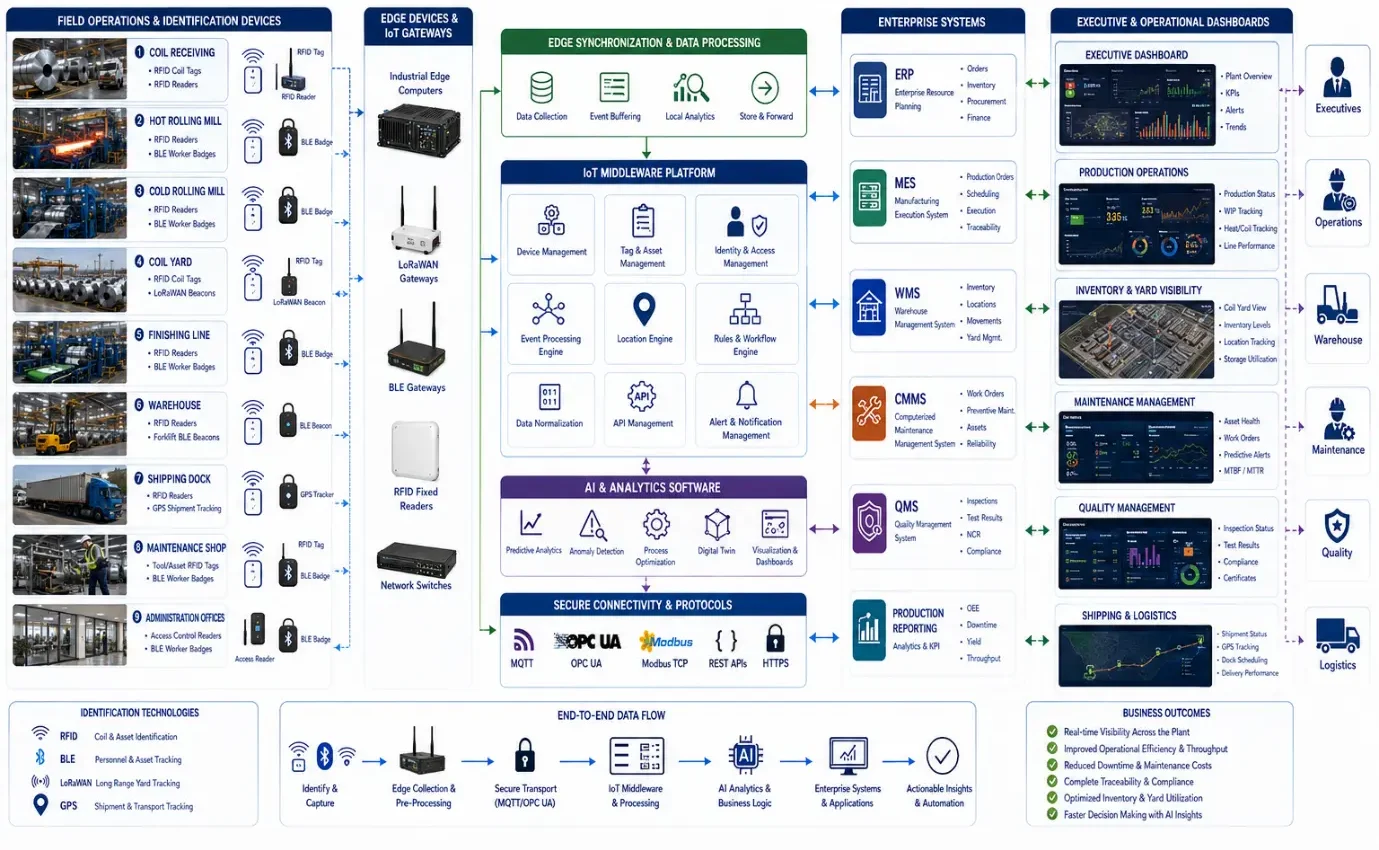
This enterprise integration diagram shows how identification and location data flows from RFID coil tags, BLE worker badges, GPS shipment tracking, and industrial edge devices through middleware and AI analytics into enterprise manufacturing systems. It demonstrates seamless integration with ERP, MES, WMS, CMMS, quality management software, and executive dashboards, enabling real-time production visibility, asset tracking, traceability, maintenance coordination, inventory management, and data-driven operational decision-making across the rolling mill.
System Connectivity for Coil, Access, and Production Data
Reliable system connectivity forms the foundation of every AI and IoT deployment within metal forming and rolling operations. Identification data has little operational value unless it reaches the software responsible for inventory control, production management, maintenance coordination, shipping, and quality documentation.
Rolling mills typically operate numerous independent software systems developed over many years. Production equipment may communicate using industrial communication standards while enterprise software manages production orders, inventory records, employee credentials, maintenance schedules, and shipment documentation. AI and IoT integration creates a common data flow between these previously independent software environments.
Instead of replacing existing software investments, MetalProcess AI integrates identification technologies with established operational systems already used throughout the facility.
Common integration objectives include:
Each identification event becomes available throughout authorized enterprise software, reducing duplicate data entry while improving operational consistency.
Integrating Personnel Identification
Worker identification is particularly important throughout rolling operations where high temperatures, moving machinery, overhead cranes, automated coil transport systems, and restricted production zones require precise access management.
BLE badges, RFID employee credentials, contractor badges, and visitor identification devices integrate with access management software to provide consistent identity verification across production buildings. Integrated personnel identification supports:
AI software analyzes identification events to identify unusual movement patterns, unauthorized access attempts, staffing bottlenecks, and operational workflow improvements without replacing existing access management software.
Integrating Coil Identification
Steel coils and aluminum coils frequently pass through multiple production stages before shipment. Each production stage generates additional manufacturing information that should remain associated with the original coil identity.
RFID coil tags provide persistent digital identities throughout production, allowing enterprise software to associate manufacturing records with each individual coil. Integrated coil identification supports:
Production personnel spend less time searching for material because identification data automatically updates inventory records as coils move throughout the facility.
Asset Identification Integration
Rolling mills depend upon numerous production assets whose availability directly affects production capacity. Examples include:
AI and IoT software associates each identified asset with maintenance history, utilization records, operating location, and availability status. Maintenance software benefits from automatic identification because equipment usage records remain synchronized with operational activity instead of relying entirely on manual data entry.
Inventory Data Synchronization
Inventory management within metal forming and rolling operations extends beyond warehouse stock counts. Facilities continuously monitor raw material coils, work-in-progress inventory, finished products, production consumables, spare parts, maintenance components, and shipping inventory.
Integrated identification systems synchronize inventory movements between operational software whenever material changes location. Inventory synchronization improves:
Rather than creating multiple inventory databases, synchronized identification events maintain consistency across existing enterprise software.
Why Integration Matters in Rolling Operations
Identification technologies produce the greatest operational value when every authorized software system works from the same trusted data source. A single RFID read, BLE location event, or GPS shipment update can automatically support inventory visibility, production scheduling, maintenance coordination, workforce management, quality documentation, and shipment verification simultaneously.
Drawing upon two decades of IoT experience through GAO and practical deployments across complex industrial environments, MetalProcess AI applies proven integration methods that emphasize interoperability, long-term maintainability, and reliable data exchange. Extensive R&D, rigorous quality assurance processes, and support from experienced engineering teams help organizations connect AI and IoT identification solutions with existing rolling mill software while minimizing operational disruption.
Edge Data Synchronization for Rolling Mill Environments
Rolling mills operate in demanding industrial environments where identification events occur continuously across production lines, coil yards, warehouses, maintenance shops, shipping docks, and employee access points. Reliable AI and IoT integration requires these identification events to be captured locally, validated, and synchronized with enterprise software without interrupting production.
Edge computing provides this local processing capability by placing computing resources close to RFID readers, BLE gateways, GPS tracking devices, industrial controllers, and access control equipment. Rather than transmitting every event directly to centralized software, edge systems collect, filter, validate, and organize identification data before forwarding it to enterprise applications.
This approach reduces unnecessary network traffic while improving response times for operational processes that depend on immediate identification.
Typical edge synchronization functions include:
For example, during coil transfers between a hot rolling mill and an intermediate storage area, hundreds of identification events may occur within a short period. Local edge processing consolidates these events before synchronizing verified movement records with enterprise software, improving both efficiency and data quality.
Local Processing for High-Volume Identification
Rolling operations often generate thousands of identification transactions during each production shift. Examples include:
Processing these events locally enables operational software to continue functioning even when external network connectivity is temporarily unavailable. After communications are restored, validated records synchronize automatically with enterprise systems while preserving complete event history.
Data Quality Before Enterprise Synchronization
Enterprise software depends on accurate identification records. Poor-quality data can create duplicate inventory records, incorrect production status, inaccurate asset locations, or incomplete genealogy documentation. Edge synchronization software improves data quality through:
These validation steps ensure ERP, MES, WMS, CMMS, quality management software, and reporting systems receive reliable operational information.
Middleware and ERP Interoperability
Most metal forming and rolling facilities operate numerous software systems that support different operational functions. Production planning, inventory management, maintenance scheduling, shipping, quality documentation, and workforce administration frequently reside within separate software environments developed by different vendors.
Middleware provides the integration layer that allows these systems to exchange identification and location information without extensive customization of existing software.
Instead of replacing proven operational software, middleware coordinates secure information exchange between identification technologies and enterprise applications.
Typical software connections include:
This interoperability enables identification data collected once to support multiple operational processes simultaneously.
ERP System Interoperability
Enterprise Resource Planning software manages many of the business processes supporting rolling mill operations, including production orders, inventory valuation, purchasing, maintenance planning, shipping documentation, and financial reporting.
AI and IoT integration enables ERP software to receive verified identification events automatically rather than relying on manual updates. Examples include:
Automated synchronization improves operational consistency while reducing manual administrative effort.
Manufacturing Execution System Connectivity
MES software coordinates production activities throughout rolling operations. Integration with AI and IoT identification solutions supports:
RFID coil identification allows MES software to associate each production step with the correct material throughout the rolling process.
Warehouse Management Integration
Warehouse operations frequently involve multiple storage locations, staging areas, shipping lanes, and inventory transfer points. Integration supports:
Warehouse personnel spend less time manually locating material because identification records remain synchronized across warehouse software.
Maintenance Software Connectivity
Rolling equipment represents substantial operational investment. Work rolls, backup rolls, cranes, transport systems, forklifts, and production tooling require accurate maintenance records.
Identification-based integration enables maintenance software to associate equipment usage with:
Accurate asset identification supports maintenance planning while minimizing unnecessary downtime.
Enterprise Middleware and ERP Integration for Identification and Location Data in Rolling Mill Operations
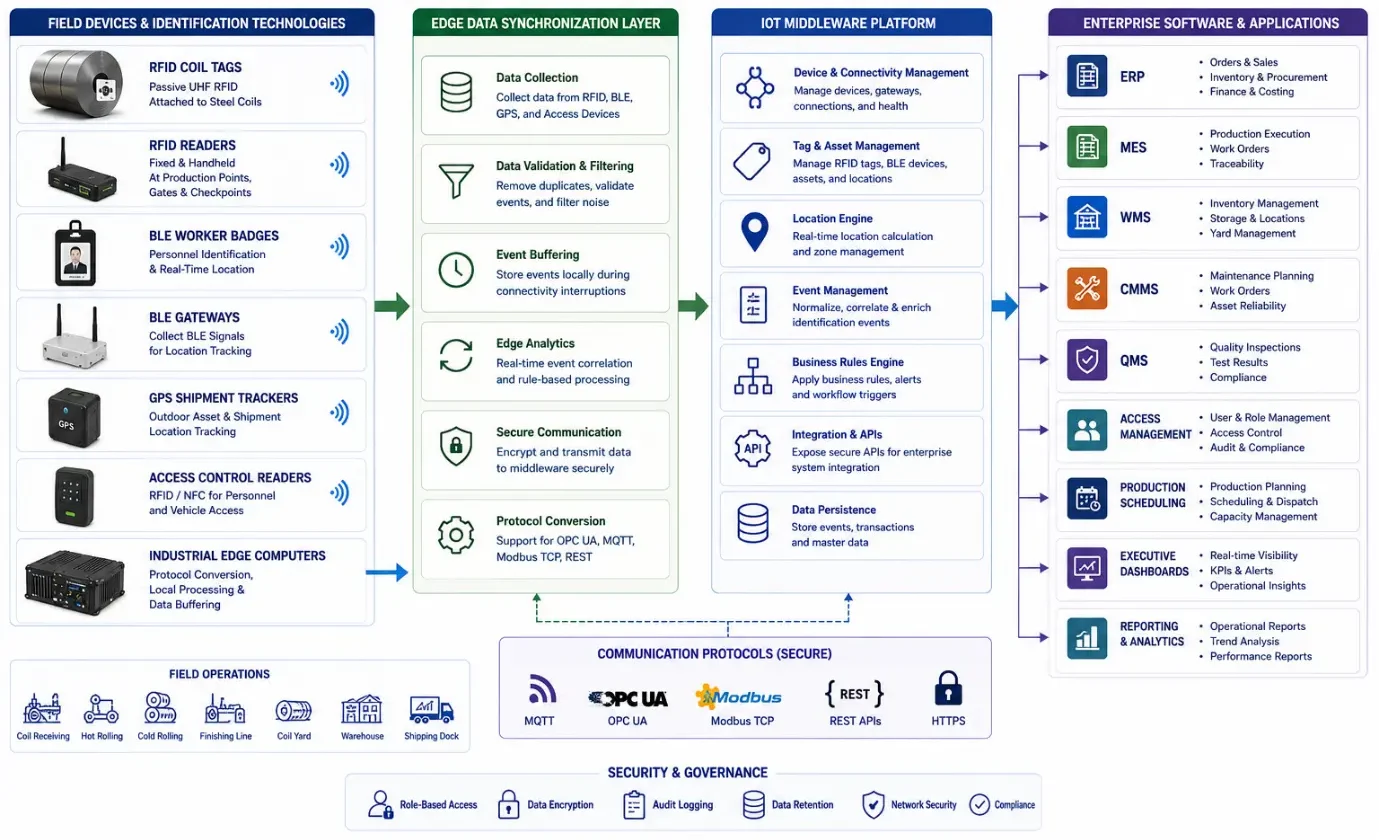
This enterprise block diagram illustrates how identification and location data from RFID coil tags, BLE worker badges, GPS shipment trackers, RFID readers, BLE gateways, access control readers, and industrial edge computers flows through edge synchronization and middleware into enterprise applications. It demonstrates secure integration with ERP, MES, WMS, CMMS, QMS, access management, production scheduling, reporting systems, and executive dashboards to support real-time operational visibility, traceability, and data-driven manufacturing decisions across the rolling mill.
Integration Benefits for Metal Forming and Rolling
A well-designed AI and IoT integration strategy allows identification information to move efficiently between production operations and enterprise software while preserving existing investments in mill systems. Organizations implementing integrated RFID, BLE, GPS, LoRaWAN, and edge computing solutions commonly improve:
MetalProcess AI applies practical integration experience derived from extensive IoT deployments supported by GAO. Drawing on two decades of experience serving industrial organizations, Fortune 500 manufacturers, research institutions, universities, and government agencies across North America, our engineering teams help organizations integrate AI and IoT identification and location solutions with existing rolling mill software while emphasizing operational reliability, interoperability, cybersecurity, and long-term maintainability.
Cloud Software Deployment for Rolling Operations
Cloud software deployment provides a centralized method for managing AI and IoT identification and location data across one or multiple rolling facilities. Organizations operating several steel mills, aluminum rolling plants, service centers, or coil processing facilities often require consistent visibility into personnel access, coil inventory, production assets, and outbound shipments regardless of geographic location.
Cloud deployment enables authorized users to securely access operational information from engineering offices, maintenance departments, production planning teams, logistics operations, and executive management. Instead of maintaining independent software installations at each site, organizations can standardize software configuration, user management, reporting, and software updates while preserving local operational control.
Typical cloud deployment use cases include:
Cloud deployment is particularly valuable when rolling operations span multiple facilities or when corporate teams require consolidated reporting across production locations.
Advantages of Cloud Deployment
Organizations selecting cloud software commonly benefit from:
The cloud deployment model remains compatible with edge computing, allowing identification events to be processed locally before securely synchronizing with centralized enterprise software.
Server Software Deployment for Mill-Managed Environments
Many primary metals producers continue to operate critical production software within company-managed server environments. Rolling mills frequently maintain strict cybersecurity policies, operational isolation requirements, or regulatory obligations that favor local software deployment.
Server deployment places AI and IoT software within the organization’s own data center or industrial computing environment. Identification data remains under direct organizational control while integrating with existing operational software.
Typical server deployment environments include:
Local server deployment supports organizations requiring direct control over software updates, user authentication, backup policies, cybersecurity procedures, and operational continuity.
Advantages of Server Deployment
Server-managed deployments provide:
Edge computing complements server deployment by reducing network traffic while maintaining rapid identification processing throughout the facility.
Choosing the Right Deployment Model
Selecting an appropriate deployment model depends upon operational requirements, organizational policies, production scale, cybersecurity strategy, and enterprise software objectives rather than technology trends. Organizations should evaluate several factors before implementation.
Cloud Deployment Is Often Appropriate When
Server Deployment Is Often Appropriate When
Many organizations adopt hybrid deployment strategies that combine edge computing, local servers, and cloud reporting. This approach allows operational processing to remain close to production equipment while providing enterprise visibility across multiple facilities.
Engineering Best Practices for AI and IoT Integration
Successful AI and IoT integration within rolling operations depends on careful planning rather than software installation alone. Identification and location technologies should complement existing operational processes while minimizing disruption to production.
Recommended engineering practices include:
These practices help maintain consistent operational data while supporting future expansion of AI and IoT capabilities.
Supporting Metal Forming and Rolling Operations with Proven AI and IoT Integration
MetalProcess AI delivers AI and IoT identification and location solutions that connect personnel, assets, coils, inventory, and production information across rolling mill operations. Rather than replacing established operational software, our integration approach enables reliable information exchange between RFID, BLE, GPS, LoRaWAN, edge computing, and enterprise business systems while supporting people tracking, access control, asset tracking, inventory visibility, work-in-progress management, and material traceability.
Developed within Aperture Venture Studio with support from GAO, MetalProcess AI is built upon practical experience gained through thousands of IoT deployments over two decades. Extensive research and development, rigorous quality assurance processes, remote and onsite technical support, and leadership from Ph.D. professionals help organizations implement reliable identification and location solutions for complex industrial environments. This experience has supported Fortune 500 manufacturers, leading research organizations, prestigious universities, and U.S. and Canadian government agencies requiring dependable industrial AI and IoT integration.
Contact Us