
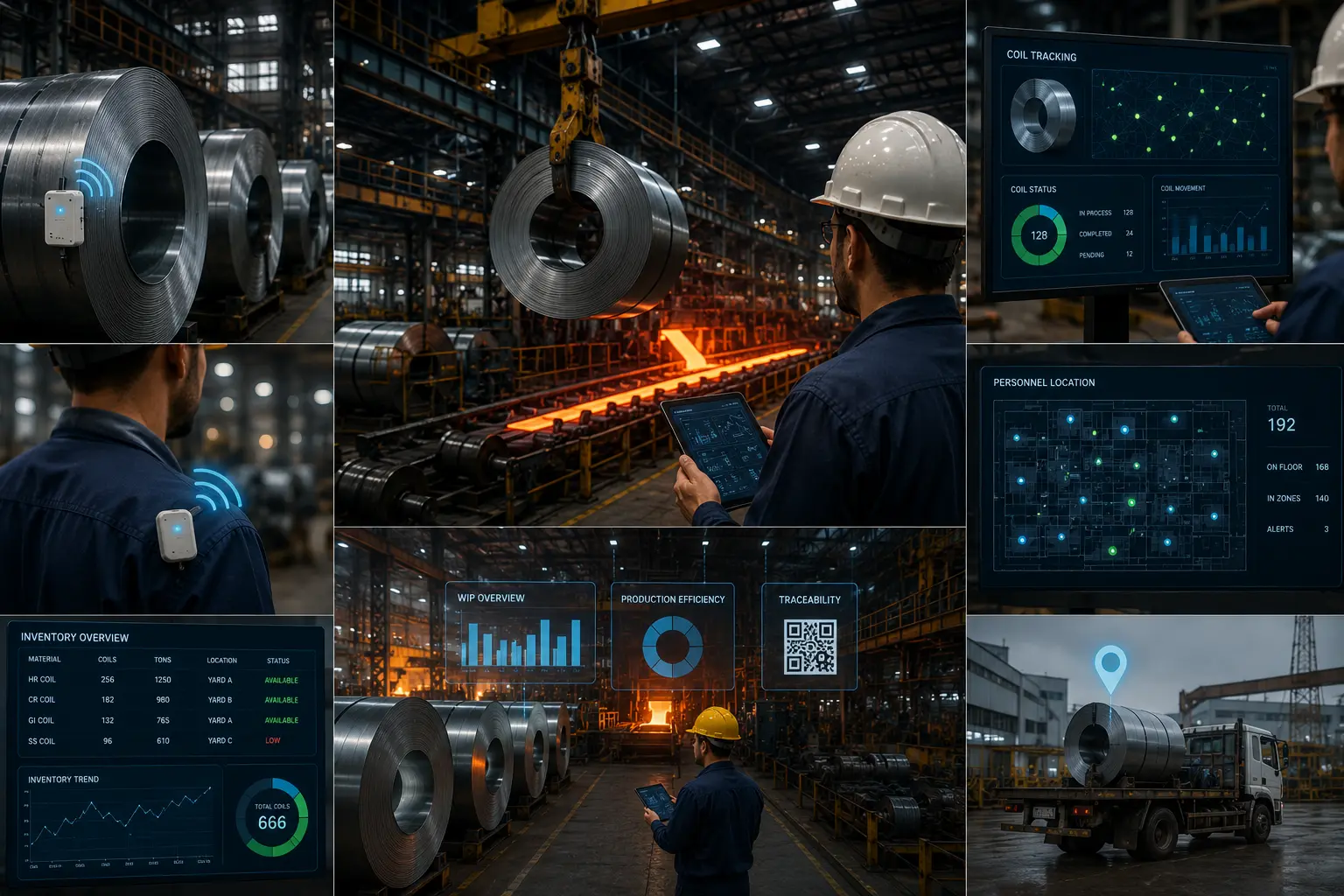
AIoT Applications in Metal Forming & Rolling Operations
Real Deployment Scenarios Where AI and IoT Improve Coil Identification, Worker Location, Asset Visibility, and Production Flow
Metal forming and rolling operations continuously move coils, slabs, billets, strip steel, rolls, dies, tooling, forklifts, overhead cranes, transfer cars, and finished products through complex production environments. Every movement influences production scheduling, inventory accuracy, material genealogy, worker safety, equipment utilization, and customer delivery performance.
AIoT combines artificial intelligence with connected identification devices, industrial communication systems, machine learning, Edge AI, computer vision, RFID, BLE, GPS, and enterprise software to transform identification and location information into actionable operational insights. Rather than depending on manual data entry or paper-based tracking, AI and IoT automatically identify personnel, assets, materials, and production status throughout the rolling process.
MetalProcess AI specializes in AI-enabled identification and location solutions designed specifically for metal forming and rolling environments. The company’s software supports worker tracking, access control, coil identification, inventory visibility, work-in-progress management, and production traceability while integrating with existing manufacturing software, ERP systems, MES software, warehouse management software, and yard management systems.
Applications focus primarily on identification and location rather than environmental monitoring. RFID coil tags, BLE worker badges, GPS tracking devices, Edge AI, and industrial communication systems enable continuous visibility from receiving through shipping while helping improve production efficiency, safety compliance, material accountability, and operational decision making.
Applications Across Metal Forming & Rolling Facilities
AI-enabled identification and location solutions support nearly every production stage within modern rolling operations. Typical application areas include:
Each production area presents unique operational requirements that determine which identification technologies, wireless communication methods, and AI software functions provide the greatest operational value.
AI and IoT Identification Workflow Across Metal Forming and Rolling Facilities
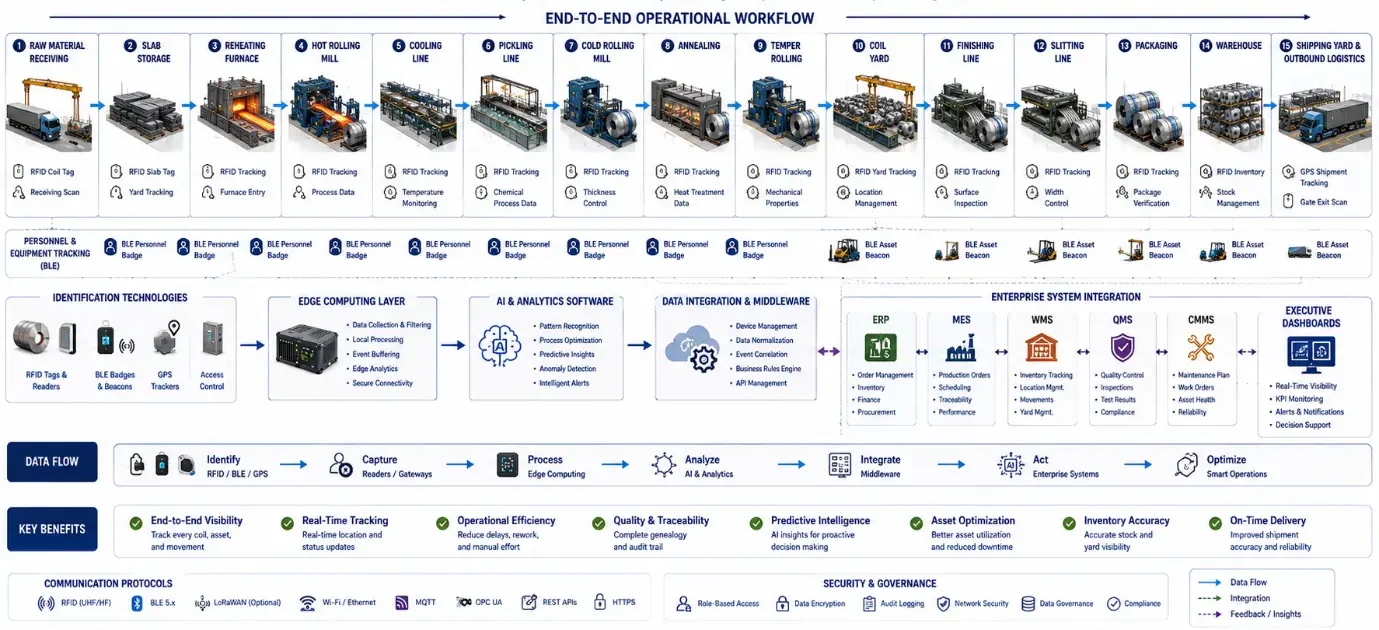
This enterprise workflow diagram represents how AI and IoT identification technologies support every stage of a metal forming and rolling facility, from raw material receiving through outbound logistics. It highlights RFID coil identification, BLE personnel tracking, GPS shipment monitoring, edge computing, AI analytics, and integration with ERP, MES, and warehouse management systems to provide end-to-end traceability, production visibility, inventory control, and operational optimization.
Hot Rolling Mill Application Scenarios
Hot rolling operations process steel slabs at extremely high temperatures while moving heavy materials through multiple production stages using overhead cranes, roller tables, transfer equipment, coil handling systems, and automated material movement equipment.
Maintaining continuous identification throughout these operations is challenging because traditional labels frequently fail under extreme heat, scale accumulation, vibration, and heavy mechanical handling. AI and IoT solutions overcome these challenges by combining industrial-grade RFID identification, AI software, computer vision, Edge AI processing, and industrial communication systems that continuously verify material identity without interrupting production.
Typical AIoT deployments within hot rolling mills include:
Coil Identification Throughout Production
Every slab entering the rolling process receives a unique production identity that remains associated with the material throughout downstream processing.
RFID coil identification minimizes manual barcode scanning while allowing production software to automatically recognize each coil during transfer between workstations.
AI software validates production routing by comparing actual material movement with scheduled production sequences. Deviations can immediately generate alerts for supervisors before incorrect processing occurs.
Continuous identification also supports:
This identification-first approach significantly reduces production errors while improving inventory accuracy.
Worker Safety and Personnel Location
Hot rolling facilities contain hazardous production zones where personnel movement must be carefully managed.
BLE worker badges communicate location information to AI software that verifies personnel presence around overhead cranes, rolling stands, reheating furnaces, pinch points, and restricted maintenance zones. Typical applications include:
Rather than replacing existing safety procedures, AI and IoT strengthen operational awareness by providing location visibility that complements established safety programs.
Asset Location for Production Equipment
Rolling operations depend on numerous mobile assets that directly influence production efficiency. Examples include:
RFID, BLE, and GPS technologies enable rapid identification of equipment location, reducing search time and improving equipment utilization.
AI software analyzes movement history to identify frequently misplaced assets, optimize storage practices, and improve production scheduling.
Production Flow Optimization
Work-in-progress visibility becomes increasingly valuable as production volume increases. AI software correlates identification events from multiple production stations to calculate:
Rather than relying on manual production reports, supervisors receive continuously updated operational information generated directly from identification events.
Cold Rolling Mill Application Scenarios
Cold rolling facilities demand significantly higher material precision than hot rolling operations. Steel strip, aluminum coil, stainless steel, electrical steel, and specialty alloys move through multiple reduction passes where exact material identity, production sequencing, and quality traceability become increasingly important.
Every production stage depends upon accurate identification of incoming coils, intermediate work-in-progress, production tooling, finished products, and personnel responsible for processing activities.
AI and IoT identification solutions improve visibility throughout cold rolling operations by integrating RFID coil tags, BLE personnel badges, industrial computer vision, Edge AI software, and enterprise manufacturing systems. Rather than relying on manual production records, each identification event automatically updates production software with verified material location, processing status, operator assignment, and inventory movement.
Typical deployment areas include:
Precision Coil Tracking Through Multiple Processing Stages
Cold rolling frequently requires a coil to pass through several processing steps, including pickling, tandem rolling, annealing, temper rolling, inspection, slitting, and packaging. Maintaining positive identification throughout this sequence is essential for quality assurance and customer order fulfillment.
RFID coil tags allow each coil to retain a persistent digital identity as it progresses through the production line. AI software compares planned routing with actual movement, helping detect routing deviations before they affect downstream processing. This approach supports accurate work-in-progress visibility, minimizes manual verification, and improves production scheduling across high-volume rolling operations.
Personnel Location During Cold Rolling Operations
Cold rolling facilities involve numerous coordinated activities between production operators, maintenance technicians, quality inspectors, crane operators, forklift drivers, contractors, and supervisors. Accurate personnel location contributes to safer operations and improves coordination during shift changes, equipment maintenance, and production changeovers.
BLE worker badges combined with AI and IoT software provide continuous location awareness across designated operational zones without requiring manual check-ins. The system associates personnel identities with authorized work areas while maintaining a historical record of location events for operational review and compliance documentation. Typical personnel location applications include:
AI software analyzes location patterns to identify workflow inefficiencies, reduce unnecessary personnel movement, and improve coordination between production and maintenance teams.
Inventory Visibility Across Cold Rolling Operations
Cold rolling facilities often manage thousands of coils at different production stages. Materials may temporarily reside in buffer storage, inspection areas, annealing queues, packaging stations, or warehouse locations before shipment.
RFID identification enables automatic inventory updates whenever coils move between operational areas. AI software continuously reconciles:
Accurate inventory visibility reduces manual cycle counting while improving production planning, customer order scheduling, and warehouse utilization.
Production managers gain near real-time visibility into material availability without depending on manual inventory reconciliation.
Quality Traceability Throughout Cold Rolling
High-value products such as automotive steel, electrical steel, stainless steel, appliance-grade steel, aluminum sheet, and specialty alloys require complete production traceability.
AI and IoT identification solutions associate every production event with a unique material identity. Production records may include:
Maintaining continuous material genealogy supports customer documentation, internal quality investigations, and manufacturing process improvements while minimizing manual data collection.
Identification-Driven Production Visibility Across Cold Rolling Mill Operations
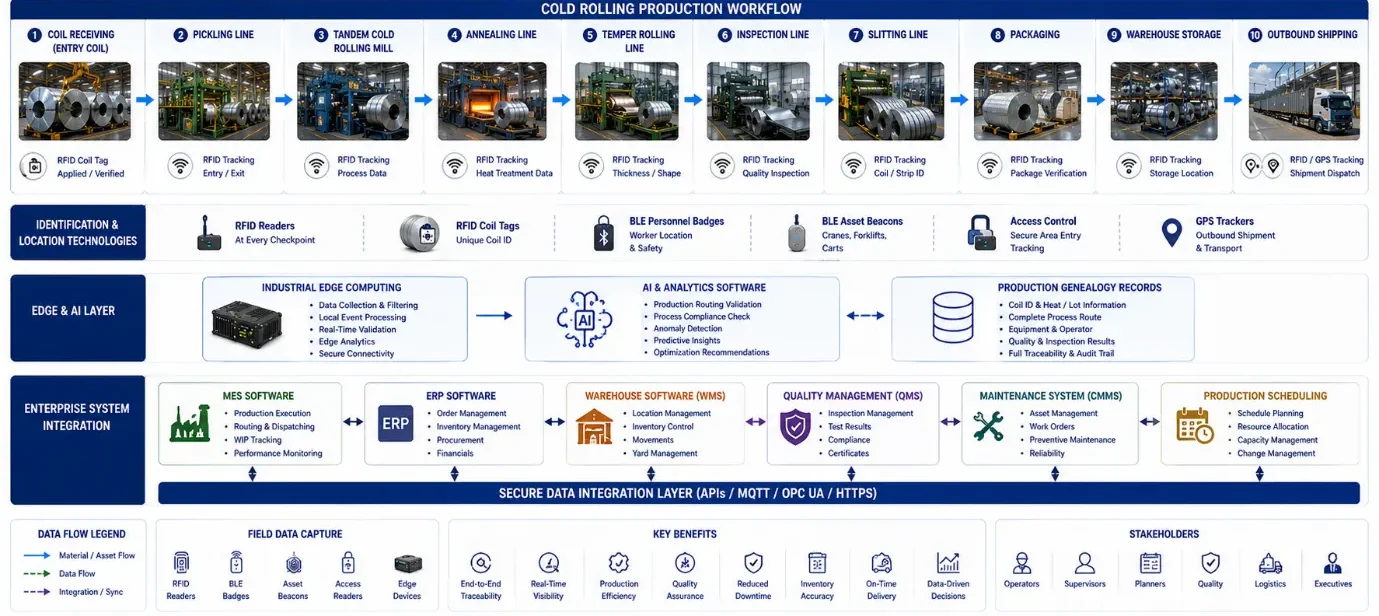
This enterprise workflow diagram shows how identification technologies provide end-to-end production visibility throughout a cold rolling facility. It shows RFID coil identification, BLE personnel tracking, AI-assisted production routing, edge computing, and integration with MES, ERP, warehouse management, and production genealogy systems to enable work-in-progress tracking, coil traceability, inventory control, and efficient outbound shipping.
Applications Summary for Metal Forming & Rolling
Although every rolling facility operates differently, several AI and IoT applications consistently deliver measurable operational improvements by strengthening identification accuracy and location visibility throughout production. Common deployment objectives include:
Rather than replacing existing manufacturing software, AIoT solutions enhance operational awareness by supplying accurate identification data that existing business systems can immediately use.
Brief Description of Applications
MetalProcess AI develops AI-enabled identification and location solutions for metal forming and rolling environments where accurate tracking of personnel, coils, rolls, tooling, inventory, and work-in-progress is essential for efficient production. Applications support hot rolling mills, cold rolling mills, coil storage yards, forming operations, finishing lines, warehouses, and shipping facilities using RFID, BLE, GPS, LoRaWAN, Edge AI, machine learning, and enterprise software integration.
Solutions help automate material identification, improve inventory visibility, strengthen personnel accountability, simplify production traceability, and increase operational efficiency without disrupting existing manufacturing systems.
Why MetalProcess AI
MetalProcess AI was created within Aperture Venture Studio with support from GAO, building upon nearly two decades of practical IoT deployment experience across industrial environments. Experience gained through thousands of IoT projects has shaped solutions specifically designed for identification and location challenges commonly encountered throughout rolling operations.
Extensive investments in research and development, rigorous quality assurance processes, and support from Ph.D.-led engineering teams enable MetalProcess AI to address complex production environments where high temperatures, heavy equipment, continuous material flow, and demanding operational schedules require dependable identification systems.
Experience supporting Fortune 500 manufacturers, leading research organizations, universities, and government agencies across the United States and Canada contributes practical engineering knowledge that informs solution design, deployment planning, enterprise software integration, and long-term operational support.
Contact Us